What Are Production Management Services?
Production management services are the hands-on coordination of everything that happens after your design is final: factory selection, sampling, tooling, quality control, scheduling, and shipment readiness. Think of it as an operating system for your supply chain. A partner runs the factory floor relationship so you get the right product, on time, at the agreed quality, order after order.
Scaling is where brands break. A product that sold beautifully at 500 units can quietly fall apart at 30,000. Defects multiply. Lead times slip. A factory that felt like a friend on the first order starts cutting corners on the third. That gap between "we made it once" and "we make it right every time" is exactly what strong production management closes.
At Klugonyx, we treat production management services and manufacturing oversight as one connected discipline, tied directly to the design and engineering work that came before it. That continuity matters, and the data backs it up.
Why Does Production Management Matter So Much When You Scale?
Because the cost of getting it wrong is brutal, and it compounds. Consider the numbers.
- Supply chain disruptions cost the average company almost 45% of one year's profits over the course of a decade, and a disruption lasting a month or longer now occurs every 3.7 years on average, according to the McKinsey Global Institute report Risk, resilience, and rebalancing in global value chains.
- The cost of poor quality in manufacturing companies averages around 15% of the sales dollar, ranging from 5% to 35% depending on product complexity, per the Institute of Industrial and Systems Engineers article Measuring the Cost of Quality. The American Society for Quality frames these as prevention, appraisal, and failure costs, and most of that total is money spent fixing things that should have been right the first time.
- A significant product recall costs, on average, in excess of $12 million, based on 367 insurance claims analyzed in the Allianz Global Corporate & Specialty report Product Recall: Managing The Impact of the New Risk Landscape. (That analysis dates to 2017, so treat it as an order of magnitude rather than a current figure.)
- Recalls are climbing, not falling. The CPSC issued 420 recall announcements in 2025, covering more than 40 million items, the highest annual total since 2007, according to the U.S. PIRG Education Fund's analysis of CPSC data. More than a quarter of those recalls involved children's products.
Those are not abstract risks. They are the exact failure modes that production management is built to prevent. When you scale, small process gaps turn into big financial holes. Oversight is not overhead. It is margin protection.
What Does A Production Management Partner Actually Do?
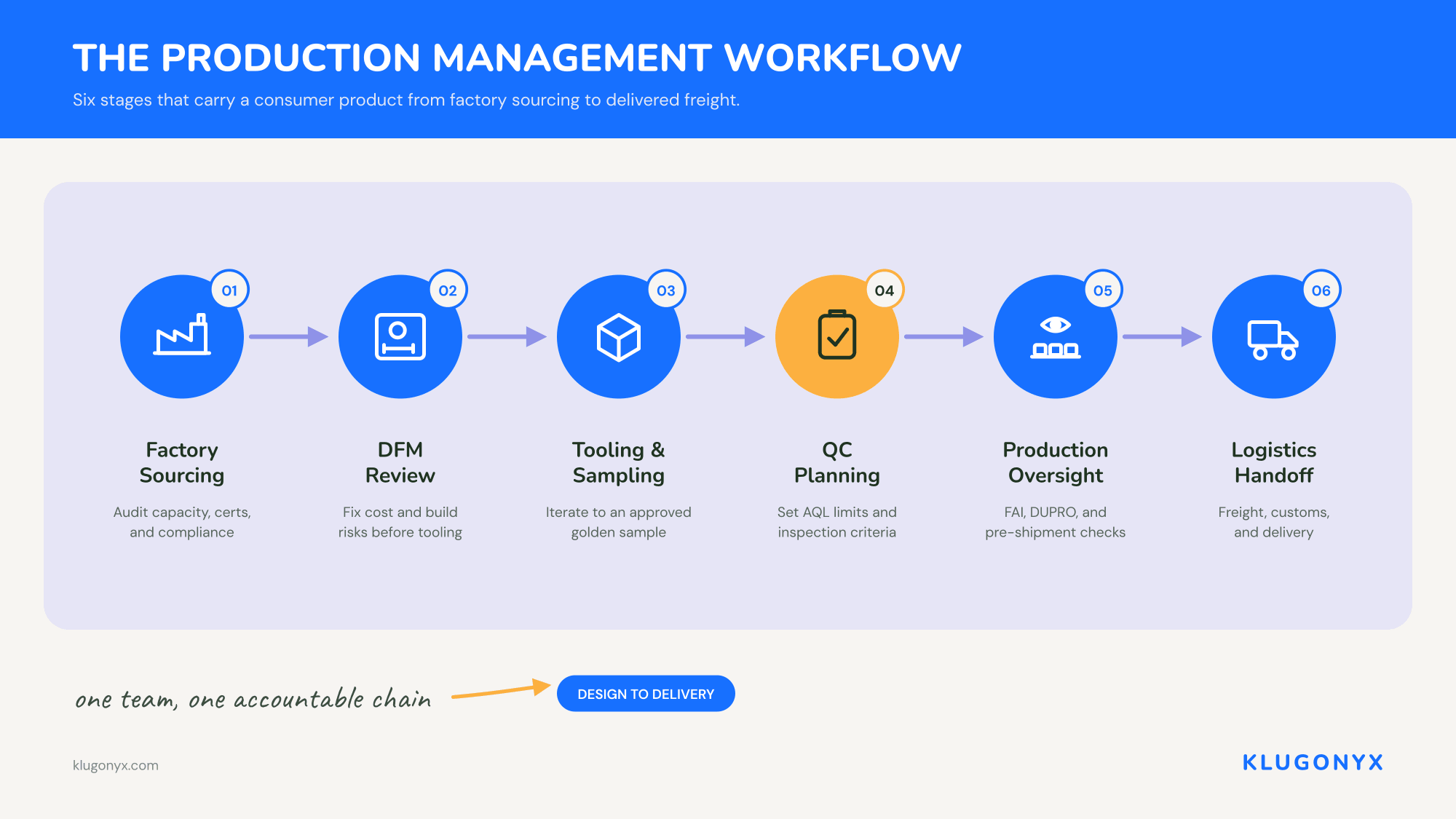
Here is the practical work, step by step. Each stage has its own vocabulary, so we define the key terms inline.
- Factory sourcing and vetting. We identify and audit factories against your real needs: capacity, certifications, compliance, and cleanliness. Good vetting goes far beyond a marketplace listing, which is why we wrote a full guide on how to vet a factory the right way.
- DFM review. DFM (design for manufacturability) is the practice of adjusting a design so it is cheaper, faster, and more reliable to produce. Catching issues here prevents the costly redesigns that derail launches, as we cover in our piece on design for manufacturing.
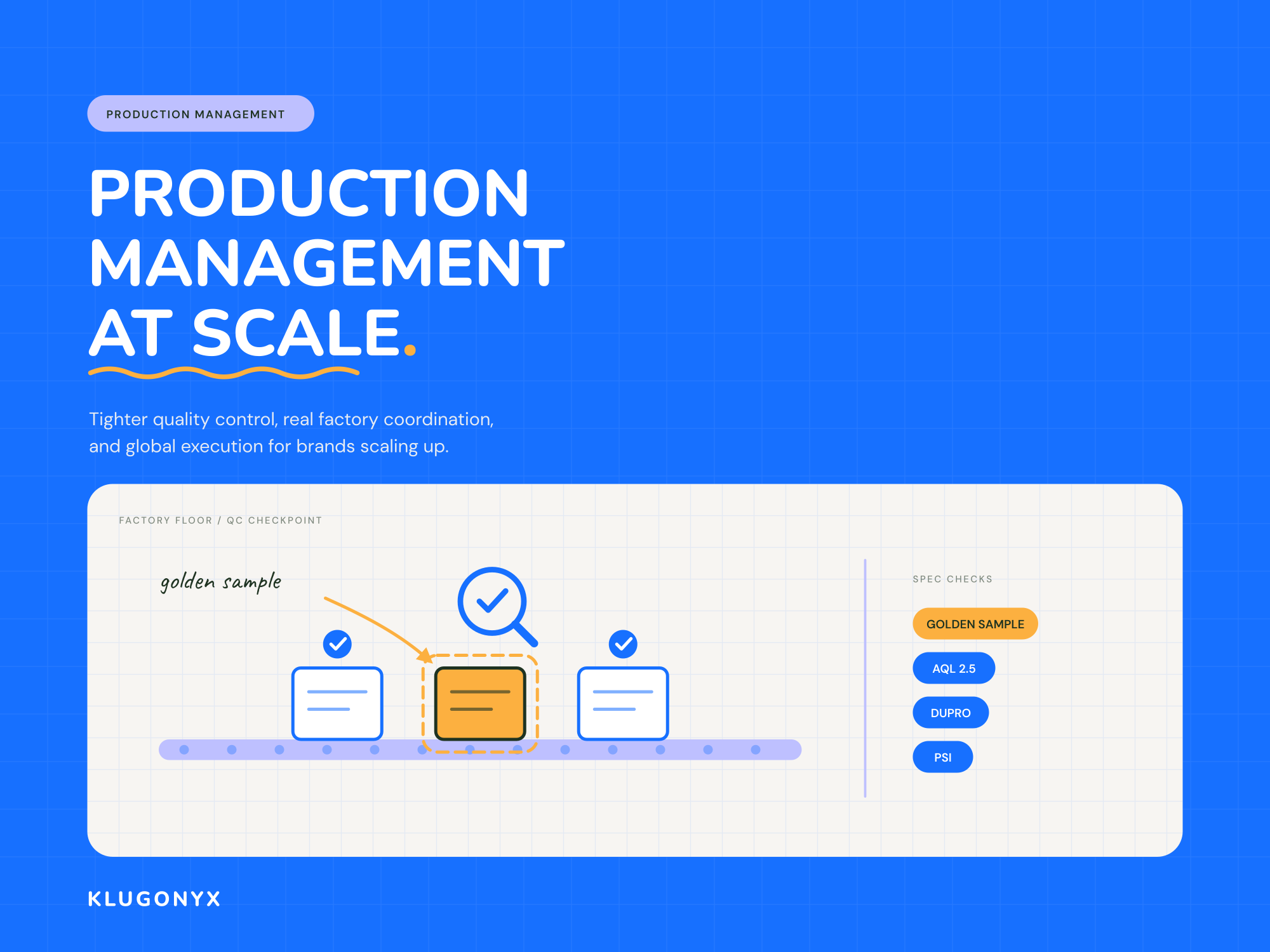
- Tooling and sampling. We run multiple sample rounds until we reach a golden sample, the approved reference unit that every production piece must match.
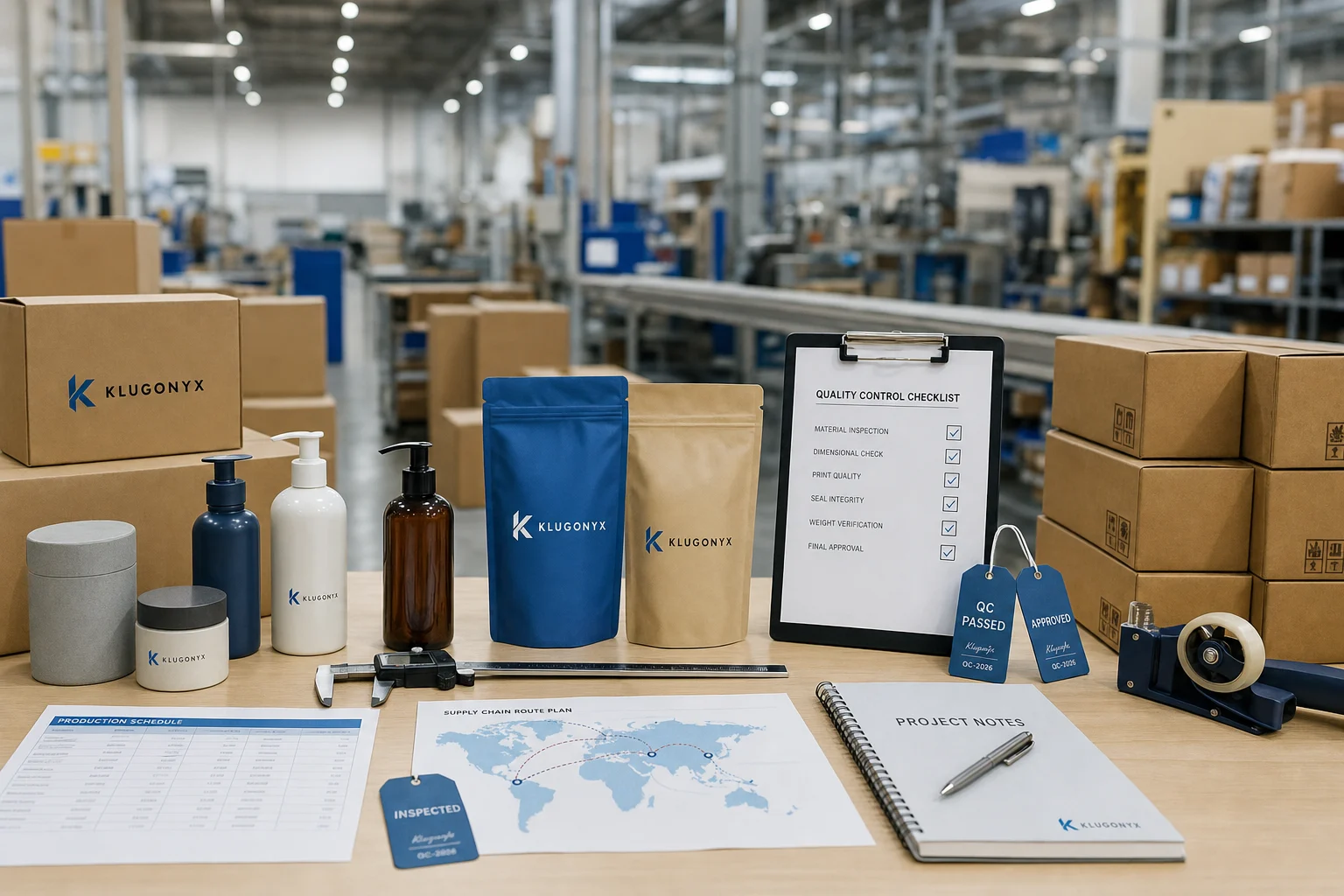
- Quality control planning. We build QC documentation from every issue found during sampling, then inspect against it. AQL (acceptable quality limit) is the statistical sampling standard that decides how many units to inspect and how many defects are tolerable before a lot is rejected.
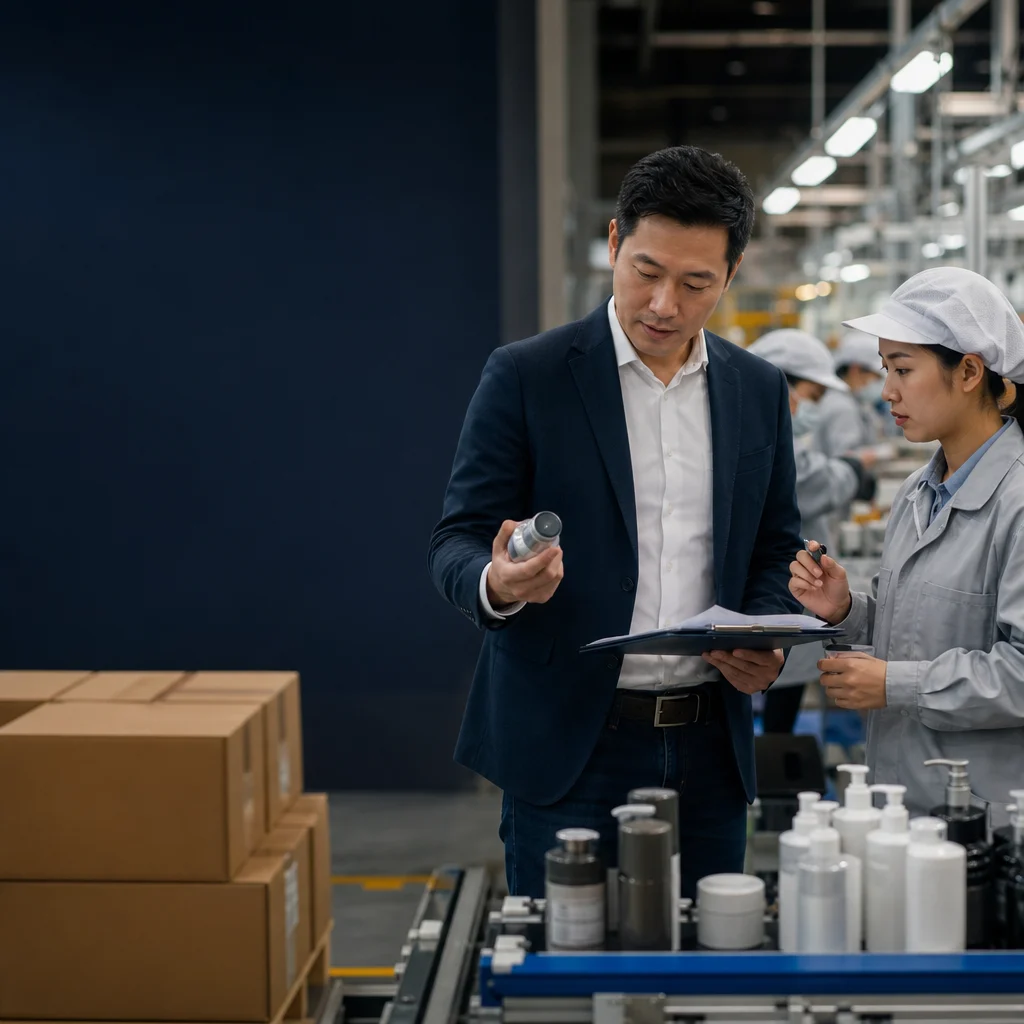
- Production scheduling and oversight. We inspect at the beginning, middle, and end of the run using during-production inspections (DUPRO) and pre-shipment inspections.
- Logistics handoff. We coordinate freight, customs, and delivery so you are not building a shipping department from scratch.
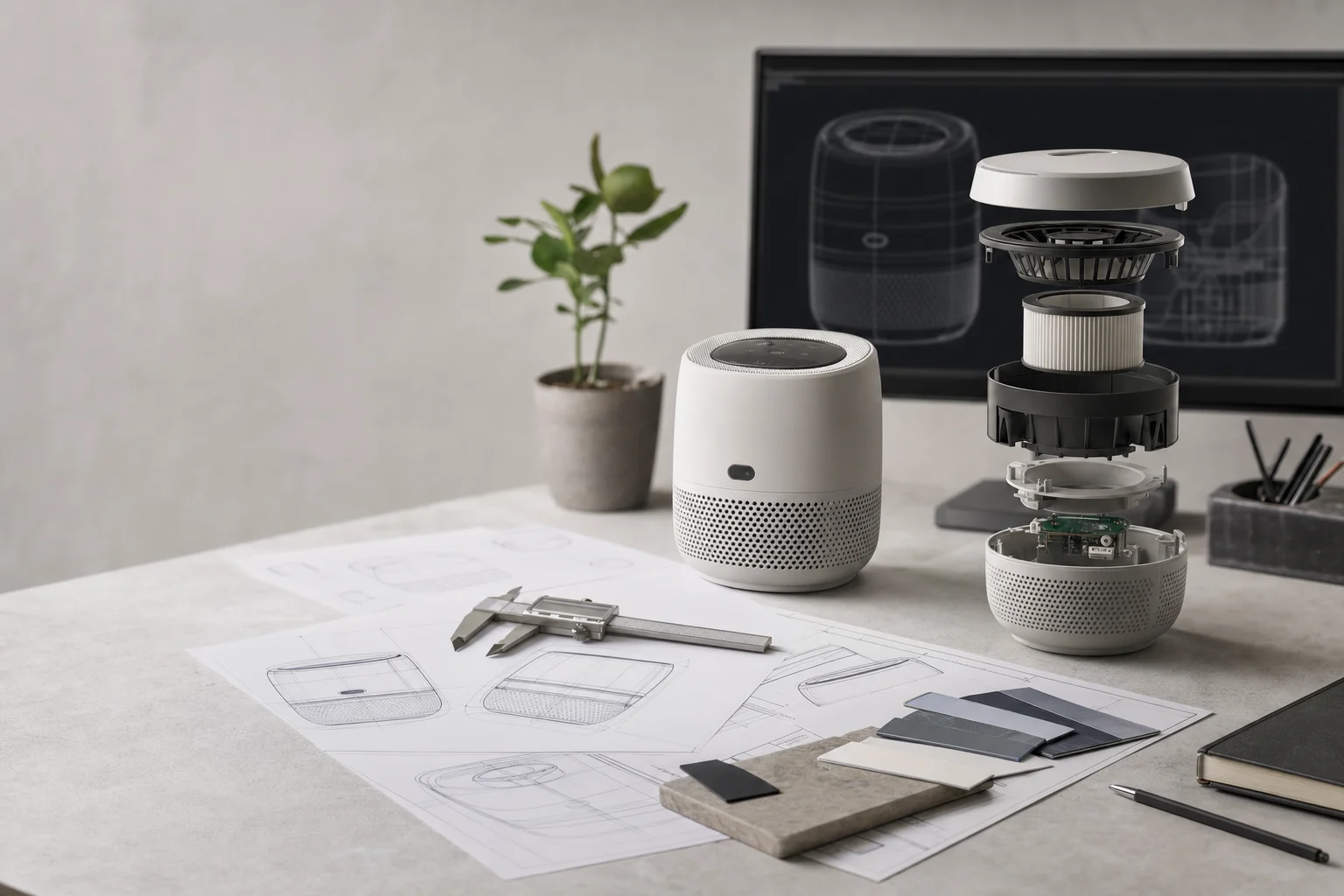
That connected chain, from product design through engineering to manufacturing, is the whole point of manufacturing operations management. When the team that designed your product also manages its production, nothing gets lost in translation.
How Do You Keep Quality Under Control At Volume?
Quality control at scale is a system, not a vibe. It rests on a few defined tools.
- Golden sample: the signed-off reference unit. Every shipment gets measured against it.
- First article inspection (FAI): verifying that the first parts off a new or modified process actually meet spec before the full run continues.
- AQL sampling: inspectors work to ISO 2859-1 (also published as ANSI/ASQ Z1.4). As third-party inspection firm QIMA explains, AQL 2.5 is the most common standard for general consumer goods, AQL 4.0 covers minor cosmetic defects, and critical safety defects are held at zero because they are simply unacceptable.
- DUPRO: during-production inspection, run while the line is still moving so problems get caught when they are still fixable rather than after the container is sealed.
- Pre-shipment inspection (PSI): a final random check once the order is produced and packed.
Compliance matters just as much, especially in regulated categories. If you sell baby and children's products, safety testing is not optional, and those 2025 recall numbers explain why. Children's products made up more than a quarter of them.
What Should You Expect On MOQs, Timelines, And Cost?
Honesty here saves you money. Very low minimum order quantities (MOQs) are real, but in our experience they are usually reserved for returning customers with established factory relationships. For a first order of a typical hard-goods consumer product, a realistic MOQ often lands closer to 3,000 units once you account for material minimums, machine setup, and tooling amortization. Anyone promising 200 units at a great per-unit price on a custom product is usually quoting sample economics, not production economics.
Timelines deserve the same candor. Moving from finished design to first production run takes longer than most founders want, which is why we published a realistic product development timeline. Production runs themselves typically take 30 to 65 days once tooling and samples are approved.
On cost, our category-by-category breakdown of manufacturing costs gives grounded ranges. Klugonyx bills at professional consultancy rates because production oversight is skilled, boots-on-the-ground work. Bringing this level of expertise in house would cost a brand a significant senior-team salary load. The right manufacturing service provider is cheaper than the recall you avoid.
How Do Tariffs And Sourcing Regions Factor In?
They factor in heavily, and this is the fastest-moving part of the picture. Flag for review: US tariff authority changed twice in 2026 alone. Confirm current rates before you budget anything.
Here is where things stand as of September 2026. On February 20, 2026, the Supreme Court ruled in Learning Resources v. Trump and Trump v. V.O.S. Selections that IEEPA does not authorize the president to impose tariffs, as summarized by the Congressional Research Service. Those IEEPA tariffs terminated on February 24 and were replaced by a temporary 10% global surcharge under Section 122, which expired by law on July 24, 2026.
What replaced it matters more for consumer brands. On July 24, 2026, USTR imposed new Section 301 forced-labor tariffs of 10% or 12.5% depending on country of origin, covering 60 trading partners and 99.4% of US imports. These are additive. They stack on top of MFN rates and, for China, on top of the existing Section 301 list duties. Certain products are exempt under the annexes, so classification work is now worth real money.
The IEEPA ruling also opened a refund path for importers who paid those duties. We wrote a step-by-step guide on how to claim an IEEPA tariff refund. (Flag for review: refund mechanics were remanded to the lower courts and remain unsettled.)
This churn is exactly why smart brands diversify. A China Plus One strategy keeps China's capability while adding a second country to reduce risk. Nearshoring has real momentum too: the Reshoring Initiative 2024 Annual Report recorded 244,000 US manufacturing jobs announced in 2024 through reshoring and foreign direct investment. For US brands, Mexico manufacturing offers shorter lead times and USMCA advantages for the right products. Strong factory management is what makes multi-region sourcing work instead of multiplying your headaches.
How Do You Manage A Growing Catalog Without Quality Drift?
As SKUs multiply, so do the ways things go wrong. On-time-in-full (OTIF) is the retail metric that captures this: it measures whether an order arrived on time and complete. Major retailers enforce it with money. Walmart charges suppliers 3% of the cost of goods on every non-compliant case, with separate on-time and in-full targets that differ for prepaid and collect shipments, as laid out in Walmart supplier compliance guidance. (Flag for review: Walmart has revised these thresholds repeatedly since 2017, so confirm current targets in Retail Link.)
Missing those targets does not just cost you the chargeback. It costs shelf space. Managing dozens or hundreds of SKUs takes structured file management, tiered prioritization, and consistent on-the-ground oversight, which we break down in our guide on managing 100+ SKUs with an overseas partner. Production planning threads a narrow needle here: enough stock to sell, not so much that cash sits dead on a shelf.
The Bottom Line For Scaling Brands
Scaling is a quality and coordination problem before it is a demand problem. The brands that win build the systems early and partner with a team that has real presence at the factory. If that sounds like the support you need, talk to Klugonyx and see our work gallery for proof.
Frequently Asked Questions
What is production management in manufacturing?Production management is the coordination of factory sourcing, sampling, tooling, quality control, scheduling, and shipment readiness so a product is made correctly and consistently at volume. It is the operational layer that turns a finished design into reliable, repeatable production.
When should a brand hire production management services?Ideally before your first production run, and definitely before you scale past a few thousand units. Early oversight prevents the defects, delays, and rework that get exponentially more expensive as order volumes grow.
What is a golden sample?A golden sample is the approved reference unit that every production piece is measured against. It captures the agreed look, fit, and function so both you and the factory share one objective standard for quality.
What is AQL and why does it matter?AQL, or acceptable quality limit, is the statistical sampling standard (ISO 2859-1 / ANSI/ASQ Z1.4) that determines how many units an inspector checks and how many defects are acceptable before a lot is rejected. It gives you an objective pass or fail decision instead of guesswork.
What is a realistic MOQ for a first production run?For many hard-goods consumer products, a realistic first-order MOQ is often around 3,000 units. Very low minimums usually go to returning customers with established factory relationships, not first-time orders on custom products.
How does production management reduce tariff and supply chain risk?A good partner builds multi-region sourcing options, such as a China Plus One or nearshoring strategy, and manages compliance and landed-cost analysis. With Section 301 forced-labor duties now touching almost all US imports, correct classification and exemption review are part of the job too.
Does Klugonyx only offer production management, or the full process?Klugonyx connects design, engineering, factory sourcing, production management, and logistics under one team. You can engage the full journey or plug us in where you need us most.