How to File an IEEPA Tariff Refund Request Through ACE: General Steps and Key Terms
*This article is a general informational overview only and is not legal, tax, or customs advice. Companies should consult their customs broker or legal counsel about their specific entries and rights.
This summary reflects CBP and court guidance as of April 2026 and may become outdated as refund procedures and litigation evolve.
Many importers are reviewing past customs entries after the 2026 IEEPA Supreme Court ruling. The basic question is straightforward: if duties were paid under IEEPA, is there a process to review those entries and determine whether a refund request may be available?
Whether a refund request is available for any given entry depends on how the entry was filed, who the importer of record was, and whether the entry is liquidated or unliquidated. Importers with fact-specific questions should review the official guidance from U.S. Customs and Border Protection and consult their customs broker or legal advisor as appropriate.
What the Court Said
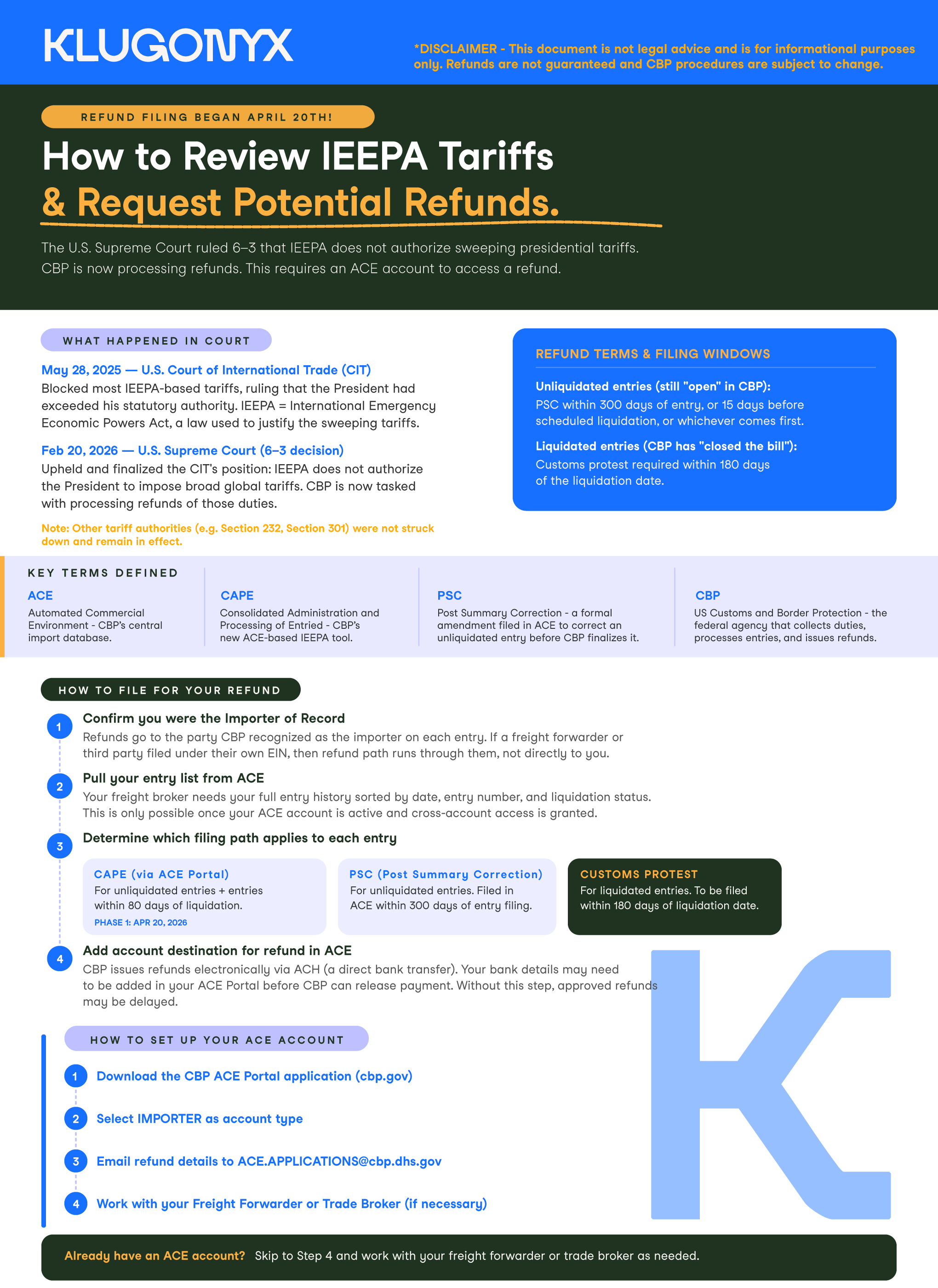
On February 20, 2026, the U.S. Supreme Court held that the International Emergency Economic Powers Act (IEEPA) does not authorize the President to impose sweeping global tariffs. You can read the opinion in Learning Resources, Inc. v. Trump on the Supreme Court's opinions page. CBP later published refund guidance on its IEEPA duty refunds page. Other tariff authorities, including Section 232 and Section 301, were not affected by the ruling.
Key Terms to Know
A few customs terms come up often in this process.
- IEEPA stands for International Emergency Economic Powers Act, the statute at the center of the Supreme Court case.
- ACE stands for Automated Commercial Environment. This is CBP's central trade portal and import database. Importers and brokers use ACE to review entries, file corrections, and manage account access. CBP explains the platform on its ACE portal page.
- CAPE stands for Consolidated Administration and Processing of Entries. This is CBP's ACE-based process for IEEPA refund requests. CBP described the rollout in its CAPE trade information notice and its CAPE declaration guide.
- PSC stands for Post Summary Correction, the process used to amend an unliquidated entry in ACE before CBP finalizes it.
- Liquidated vs. unliquidated entries: A liquidated entry is one where CBP has made its final duty calculation. An unliquidated entry is still open and not yet finalized. CBP's refund and PSC guidance uses that distinction throughout the filing process.
Who the Filing Is Tied To
In general, the filing is tied to the Importer of Record listed on the entry.
That means the first practical step is confirming which company or entity appears as the importer of record in ACE. If a customs broker, freight forwarder, or another entity filed under a separate importer number, that may affect how the entry is reviewed and how refund processing is handled. CBP's guidance and ACE account materials both treat the importer account structure as a foundational part of the process.
What Filing Paths Does CBP Describe?
CBP's current guidance points to three general filing paths, depending on the status of the entry.
CAPE is CBP's process for certain IEEPA refund requests through the ACE Portal. CBP states that Phase 1 begins on April 20, 2026.
PSC (Post Summary Correction) applies to certain unliquidated entries in ACE.
Customs protest may apply to certain liquidated entries.
A Step-by-Step Overview of the Process
Step 1: Confirm the Importer of Record
Start by identifying who was listed as the importer of record for each entry. This clarifies which company or entity should review the entry and coordinate any filing. In most cases, this can be confirmed through ACE or with a customs broker. Relevant account setup information is available on CBP's ACE portal application page.
Step 2: Pull the Entry List from ACE
Next, review the company's entry history in ACE. Importers typically sort entries by date, entry number, importer of record, and liquidation status. That framework helps determine which entries need additional review.
Step 3: Identify Whether Each Entry Is Liquidated or Unliquidated
Once the entries are pulled, determine the liquidation status for each one, since that drives which filing path applies. CBP's IEEPA FAQ, PSC page, and Protests page are the most useful starting points for understanding that distinction.
Step 4: Match Each Entry to a Filing Path
After the entries are organized, determine which filing path may apply to each one:
- CAPE may apply to certain entries being processed through the ACE Portal for IEEPA refunds.
- PSC may apply to certain unliquidated entries.
- Customs protest may apply to certain liquidated entries.
Step 5: Confirm Banking Information in ACE
CBP states that refunds are issued electronically, so the ACH banking information associated with the ACE account should be current before refund processing begins. CBP notes this on its IEEPA duty refunds page. Its ACE managing accounts page covers broader account administration.
Do You Need an ACE Account?
In most cases, ACE access is part of the process.
CBP's refund guidance, CAPE rollout notices, and portal documentation all point back to ACE as the central place for account access, entry review, and filing administration. Importers can start with CBP's ACE application page.
Where to Get Help
For most importers, the first point of contact is their customs broker. A broker can typically help review entry history, identify liquidation status, and confirm how entries were filed.
For account setup or portal access questions, CBP provides direct support through the ACE Support page and the ACE Account Service Desk. CBP's portal application page also notes that importers can check with their customs broker or another trade partner when trying to identify an existing account.
For entry-specific or legal questions, importers may also choose to consult a customs attorney or trade advisor, particularly for advice tailored to their own facts and filings. CBP's Protests page is a useful official reference for understanding the protest process in general.
Final Summary
The 2026 IEEPA ruling has prompted many importers to review earlier customs entries and consider whether refund filing may be available for certain duties.
A practical starting point is to confirm the importer of record, pull the entry list from ACE, review liquidation status, match each entry to the appropriate filing path, and confirm that ACE access and ACH information are in place. From there, CBP's official guidance, a customs broker, or a legal advisor can help determine what to review next.
Frequently Asked Questions
The following FAQs summarize common questions importers are asking based on current public guidance.
Are all tariffs affected by the IEEPA ruling?
No. The Supreme Court ruling addressed tariffs imposed under IEEPA. CBP's refund page makes clear that other tariff authorities, including Section 232 and Section 301, were not affected by the ruling.
What is the difference between CAPE and PSC?
CAPE is CBP's ACE-based process for IEEPA refund requests. PSC, or Post Summary Correction, is the standard ACE-based process for correcting certain unliquidated entries before CBP finalizes them. CBP explains each process separately in its CAPE notice and PSC guidance.
Where can I set up or fix ACE access?
The best starting points are CBP's ACE portal application page, the ACE Secure Data Portal application form, and the ACE Support page.
Save the one-page image below for quick reference on next steps: