How Much Does It Cost to Design and Manufacture a Product? Real Ranges by Category
"How much is this going to cost?" It's the first real question every founder asks, and it's the one that gets the vaguest answers. You'll hear "it depends" more times than you can count, and while that's technically true, it's not very useful when you're trying to figure out whether your idea is even viable.
So let's be more useful than that. Product design and manufacturing cost varies significantly by product category, complexity, and where you're sourcing. But there are real ranges. And understanding them, even roughly, changes how you plan your budget, your timeline, and your conversations with partners.
This guide breaks down what you should actually expect to spend across five popular consumer product categories: baby products, outdoor gear, home goods, pet products, and toys. We'll walk through every major phase of the process, from design all the way to per-unit production cost.
The Five Phases of Product Development (and Where the Money Goes)
Before we get into categories, it helps to understand the phases where costs accumulate. Most founders are surprised to learn that manufacturing is not where the biggest surprises hide. The pre-production work is where underprepared teams run out of runway.
Here's how to think about the major cost buckets:
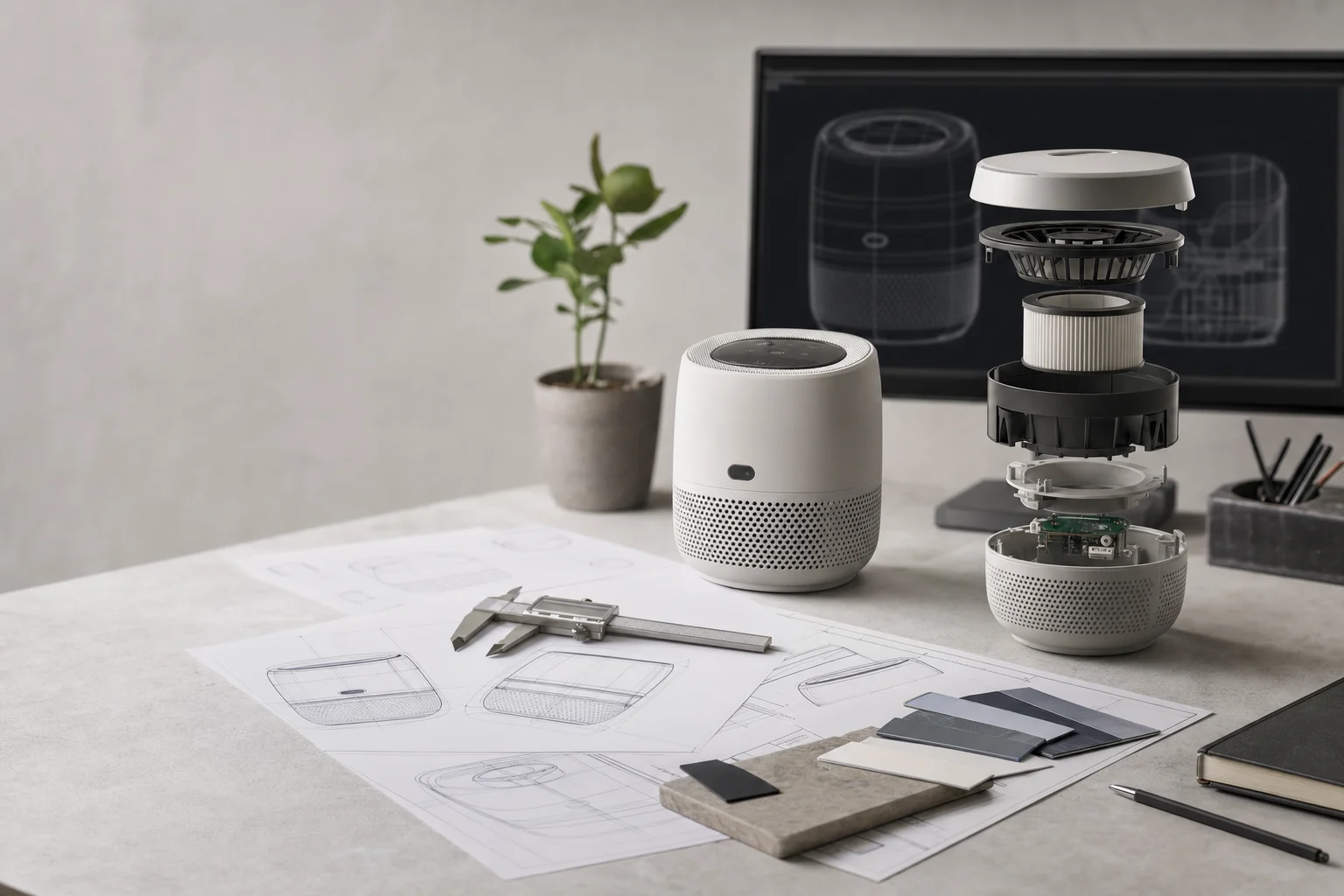
1. Industrial Design: This is the concept and visual phase: how your product looks, how a user interacts with it, and how it gets shaped into something buildable. Costs include ideation, concept sketching, 3D rendering, and CMF (color, material, finish) direction. From our experience, industrial engineering alone across more complex projects can range from $15,000 to $60,000.
2. Engineering and Product Development: This phase translates the design into something manufacturable. It includes CAD modeling, tolerancing, material selection, and DFM (design for manufacturing) review. Learn why DFM can make or break your product. A DFM review typically costs $200 to $500, but we always tell our clients that it carries an average return of 10 to 20x by catching problems before steel is cut.
3. Tooling: For any product with injection-molded, die-cast, or stamped components, tooling means fabricating the physical molds used in production. Industry pricing guides put the range at roughly $1,500 for a simple single-cavity mold from China to $100,000 or more for a complex multi-cavity steel tool. This is almost always a significant upfront cost. The good news: you typically pay it once.
4. Sampling and Prototyping: Before you commit to a production run, you need physical samples to test fit, function, and quality. This phase often includes multiple sample rounds. Manufacturing setup and pre-production prototype costs typically start at $30,000 for basic products and move upward from there.
5. Per-Unit Production Cost: The cost to make one unit at your target order quantity, typically quoted as EXW (ex-works) or FOB (free on board) from the factory. At production volumes, injection-molded part costs typically range from $0.50 to $5.00 per component depending on size, material, and complexity. Volume has a major impact on where you land in that range.
Product Design and Manufacturing Cost by Category
Baby Products
Baby products carry premium expectations on safety, materials, and regulatory compliance. That raises costs across the board, but the category is also one of the most consistent in terms of what drives spend.

What drives costs up: Soft goods (fabric, cushioning, stitching) add complexity and vendor coordination. Products that fall under the Consumer Product Safety Improvement Act require mandatory third-party testing at a CPSC-accepted laboratory. Lab fees and Children's Product Certificate (CPC) compliance through accredited labs like QIMA can run $1,500 to $3,000 and up, depending on product complexity. Silicone or BPA-free certified materials increase per-unit cost meaningfully.
What keeps costs manageable: Simple baby accessories like bibs, teethers, and basic soft carriers can come in at the lower end of this range, especially if the design does not require complex tooling or multi-material construction.
Outdoor Gear
Outdoor gear spans a wide range, from simple accessories to complex technical equipment. It's one of the categories where engineering spend has the most leverage: a well-engineered product performs better and fails less in the field.

What drives costs up: Multi-component assemblies (hinges, buckles, straps, hardware) require more tooling setups and more vendor coordination. Products with mechanical function, like adjustable frames or locking mechanisms, add meaningful engineering time. Mechanical engineering alone for complex products runs $10,000 to $50,000. Premium materials like aircraft-grade aluminum, reinforced nylon, and waterproof coatings increase per-unit cost significantly.
What keeps costs manageable: Soft-goods-heavy products (bags, straps, wraps) with minimal tooling components tend to hit the lower end of the production range. Products designed specifically for nearshore manufacturing in Mexico can also see meaningful savings on labor-intensive assembly.
Home Goods
Home goods is a broad category, so let's anchor on mid-complexity products: kitchenware, organizers, small decor items, and functional household accessories. These tend to be the products early-stage founders bring to market first.
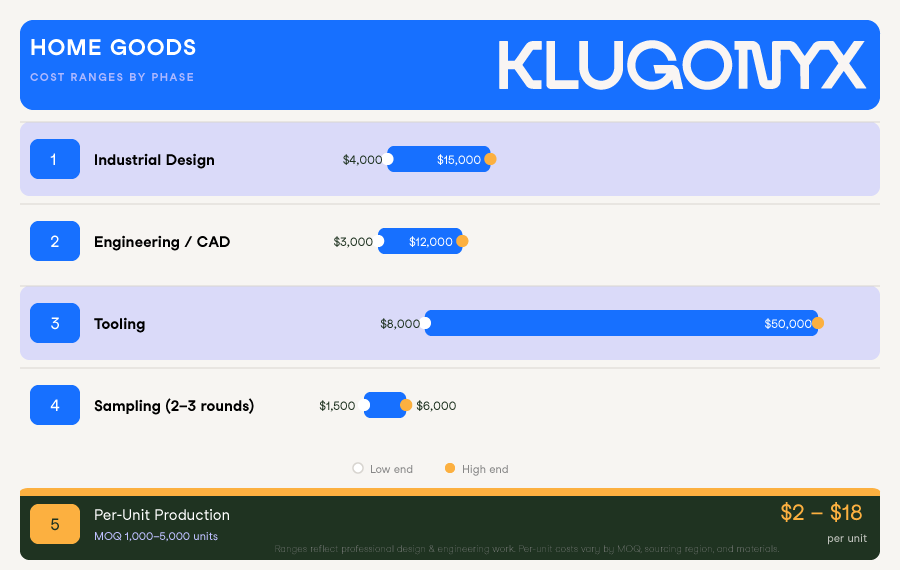
What drives costs up: Products with electrical components (small appliances, lighting, powered gadgets) add UL certification requirements and more complex engineering. Multi-part assemblies with tight tolerances require more tooling precision, which raises mold cost. As Zetar Mold's 2025 pricing data shows, CNC machining labor accounts for 40 to 50 percent of total mold cost, and at $20 per hour in China versus $120 per hour in the U.S., sourcing location has a dramatic effect on your tooling invoice.
What keeps costs manageable: Simple single-material injection-molded or cast products with straightforward geometry are among the most affordable categories to tool and produce. Home goods is also one of the categories where China and Vietnam have the deepest supplier ecosystems, often keeping per-unit costs competitive.
Pet Products
The pet products market has grown substantially in sophistication. Owners now expect the same quality standards they'd apply to their own gear. That has pushed engineering and material expectations upward.
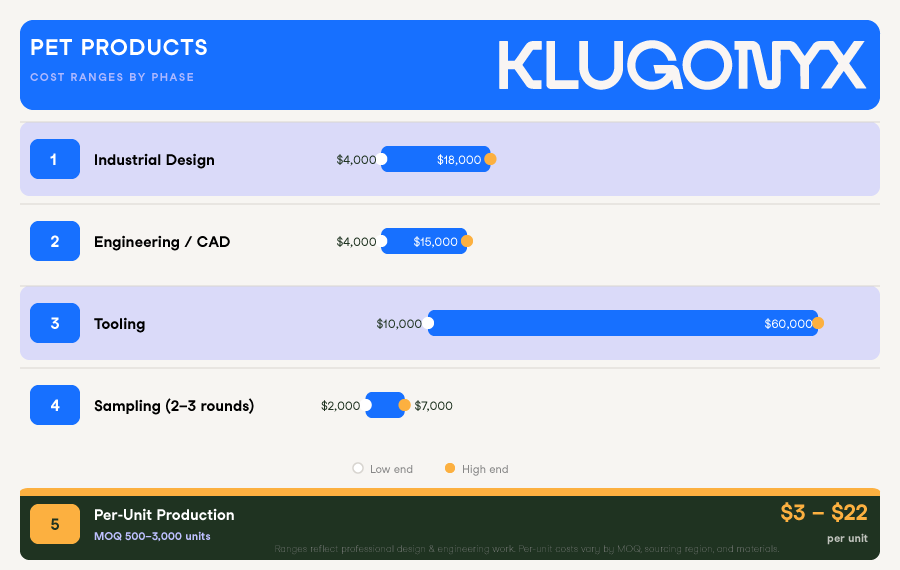
What drives costs up: Products that contact animals directly often require food-grade or non-toxic material certifications, especially for bowls, chews, and wearables. Products for larger animals require sturdier construction and higher-gauge materials. Personalization or modular features add assembly complexity. Per-unit cost is highly sensitive to where production happens: as of late 2024, average manufacturing wages sit at roughly $6.50 per hour in coastal China, $4 to $5 per hour in Mexico, and $2 to $3 per hour in Vietnam. For a labor-intensive pet product, that spread matters.
What keeps costs manageable: Simple accessories with standard materials like leashes, basic collars, and plastic feeders stay firmly at the lower end. If your product is primarily soft goods and simple hardware, tooling investment can be minimal.
Toys
Toys face some of the tightest regulatory scrutiny of any consumer category, which makes them a genuinely challenging first product for founders who haven't navigated compliance before. Budget for testing early.

What drives costs up: All toys designed for children under 12 and sold in the U.S. must comply with ASTM F963-23, the current mandatory toy safety standard under CPSIA that became effective in April 2024. Third-party testing at a CPSC-accepted lab is required for most children's products. Testing and CPC certification typically runs $1,500 to $3,000 for a basic product, and more for complex toys with electronics or age-graded components. Electronics integration adds significant engineering time on top of that.
What keeps costs manageable: Simple educational toys, wooden toys that skip injection molding entirely, and non-electronic games sit at the lower end of this range. Working with a manufacturing partner experienced in toy compliance from day one avoids costly redesigns downstream.
The Numbers You Shouldn't Ignore: Total Pre-Production Investment
Here's a realistic summary of total pre-production spend (design through first sample approval) before you place your first production order:
- Simple product, low complexity: $15,000 – $40,000
- Mid-complexity product: $40,000 – $100,000
- Complex product (electronics, multi-component, tight compliance): $100,000 – $250,000+
These ranges assume professional design and engineering work, not DIY or offshore-only development. They also assume you're building something with real IP and a production-ready tooling package, not a white-label swap.
If you're curious how sourcing location affects these numbers, the China Plus One strategy guide covers how Vietnam, Mexico, and India each stack up on cost and capability. The USA vs. China comparison is worth reading too if you're weighing domestic options for any phase of production.
For a detailed look at how Klugonyx manages the factory selection and production ramp, the factory sourcing checklist is a good place to start.
What This All Means for Your Budget
The most common mistake founders make is funding their first production run without accounting for the full pre-production runway. A $50,000 production order means very little if you've already burned through your budget in tooling and your samples aren't approved yet.
Build a budget that covers the full arc: concept to sample approval, then production. Give yourself a 20% contingency at every phase, because materials change, samples fail, and revisions happen on even the cleanest projects.
And if you're unsure where your product lands in these ranges, the fastest way to find out is to get a real scope assessment with a partner who has done it before. Talk to Klugonyx about your product.
Frequently Asked Questions About Product Design and Manufacturing Cost
What drives the cost difference between simple and complex products?
Complexity in product development comes down to four main factors: the number of unique components, the precision required to manufacture them, the materials involved, and the regulatory standards the product has to meet. A simple single-material product with one tool and no electronic components can move from design to production for $15,000 to $40,000. A multi-component product with electronics, certifications, and tight tolerances can require $150,000 or more before you produce a single unit for sale. The more moving parts, the more phases of the process compound in cost.
Is tooling a one-time cost or do I pay it again on reorders?
Tooling is a one-time upfront cost. Once your molds are fabricated and approved, they're used for every subsequent production run at no additional tooling charge. Steel production molds typically run 500,000 or more cycles, so for most early-stage and mid-size brands, the original tool investment covers the full lifecycle of the product version. You only repay tooling if you make a design change that requires modifying or rebuilding a mold. One useful way to think about it: at 10,000 units, a $10,000 mold adds $1.00 per part in amortized tooling cost. At 100,000 units, the same mold adds $0.10 per part.
How much should I budget for sampling before production?
Plan for at least two to three sample rounds for most products. A realistic sampling budget is $2,000 to $12,000 depending on the product, with each round accounting for factory samples, shipping, and any revision costs. More complex or multi-component products sit at the higher end. It's worth building this into your pre-production budget as a non-negotiable line item. Rushing through sampling to save money is one of the most common causes of costly quality failures at production.
Why do costs vary so much between China, Vietnam, and Mexico?
Each country has a different labor cost structure, material availability, factory specialization, and overhead. As of late 2024, average manufacturing wages in coastal China sit around $6.50 per hour, Mexico runs $4 to $5 per hour, and Vietnam comes in at $2 to $3 per hour. However, wages alone don't tell the whole story. China's deep supplier ecosystem and decades of tooling infrastructure often offset its higher labor costs, particularly for injection-molded and electronics-heavy products. Mexico's advantage is proximity to the U.S. market and USMCA duty benefits, which shortens lead times and reduces total landed cost for brands shipping to American retail. Vietnam excels in labor-intensive manufacturing like soft goods, textiles, and mid-tier assembly. The right country depends on your product type, your volume, your timeline, and a careful analysis of total landed cost, not just factory price.
Does Klugonyx charge differently for design-only vs. full-service projects?
Yes. Klugonyx offers both design-only engagements and full-service projects that include design, engineering, factory sourcing, and production management. The scope and structure are tailored to your project. Full-service engagements give you a single coordinated team across every phase, which reduces handoff risk and keeps your timeline tighter. Design-only work is an option for founders who already have a manufacturing relationship but need professional concept and engineering development. Reach out to discuss which path fits your project.
Klugonyx is a full-service product design, engineering, and manufacturing partner. We help entrepreneurs and brands move from concept to production with a clear process, real expertise, and factories we've already vetted. Learn how we work.