Factory Sourcing Checklist: Are You Really Ready for Your First Production Run?
Getting a product ready for its first production run is both exciting and stressful. You are trying to juggle design decisions, factory options, budgets, timelines, and a constant stream of what if questions. It is very easy to start factory sourcing before you are truly production ready, and that is usually when delays, quality problems, and surprise costs show up.
This is why we created a Factory Sourcing and First Production Run Checklist. It is a practical factory sourcing checklist you can walk through before you request quotes or place your first purchase order. Instead of guessing whether you are ready, you can evaluate your project against clear criteria and see exactly where you are solid and where you probably need help.
Download the checklist
Grab the free Factory Sourcing and First Production Run Checklist to follow along as you read. It gives you a structured, fillable document you can use with your team.
What Is a Factory Sourcing Checklist and Why It Matters
A factory sourcing checklist is simply a structured way to confirm that you have covered the essentials before you start talking to factories or committing to a production run. Instead of asking a vague question like “Are we ready” and getting an equally vague answer, the checklist pushes you to look at specific areas. It asks whether your design files are truly ready for manufacturing, whether you have a clear idea of your target landed cost and realistic minimum order quantities, whether you have thought through which country or region makes the most sense for this product, and whether you have even a basic plan for quality, testing, and logistics.
Checklists have long been used in manufacturing and operations to reduce errors and keep processes consistent. For consumer product brands, a production ready checklist is often the difference between a smooth first run and a very expensive learning experience. It does not guarantee perfection, but it significantly reduces the odds that you will overlook something fundamental.
Signs You Are Not Actually Production Ready
Many brands feel ready for a factory conversation long before they have the foundations in place. You might recognize some of these patterns. You have a strong idea and some sketches, but no final CAD or tech pack. You are hoping your pricing and margins will work out once you see quotes rather than starting from clear cost and margin targets. You picked a manufacturing country based on a friend’s suggestion rather than a deliberate strategy. You plan to figure out safety testing and certifications after the first batch arrives. You do not have a clear sense of timing from purchase order to production to shipping and arrival.
None of these issues are fatal on their own, but together they are a clear sign that you are not truly production ready. A good first production run checklist does not exist to nag you about details. It exists to expose these gaps early, while they are still relatively cheap and easy to fix.
The Nine Key Sections of a Strong Production Ready Checklist
Inside the Factory Sourcing and First Production Run Checklist we break readiness into nine sections. In the download, each section contains detailed prompts and checks. Here we will walk through them at a high level so you can see how a manufacturing checklist should flow.
1. Project Basics: Can You Explain Your Product in One Breath
The first section is all about clarity. Before you even think about a manufacturing checklist, you need a simple, shared understanding of what you are building. You should be able to describe your product in one sentence, name the category it belongs to, such as baby, toys, outdoor, home goods, wellness, apparel, or pet, and clearly state who your primary customer is and how they will use the product. It also helps to have at least one reference product that is similar in quality or price.
If you cannot answer these questions quickly and consistently, factories will struggle to quote and build your product accurately, because they will be guessing about your expectations.
2. Design and Engineering Readiness: Are Your Files Truly Ready for the Factory
This is the section where many teams discover they are not as far along as they thought. You are much closer to production ready when you have production intent CAD files or tech packs rather than moodboards and loose sketches. You should also have a basic Bill of Materials that lists parts, materials, and finishes, and ideally a working prototype or golden sample that represents the final size and function as closely as possible.
It is equally important to know which features are absolutely required and which features are nice to have if budget and complexity allow. You should understand any performance requirements such as load limits, durability expectations, or temperature ranges. If you are missing several of these items, you are still in product design and engineering mode. Starting factory sourcing too early tends to create rework, misquotes, and serious delays.
3. Costs, Volumes, and Pricing: Will the Math Actually Work
A realistic factory sourcing checklist forces you to face the basic math before you invest time in quoting. You should have a target retail price range and a rough target landed cost, including freight and tariffs, that will allow you to hit acceptable margins. You should know how many units you can realistically order in your first production run and what your reorder volumes might look like if the product sells well.
You do not need to know the exact per unit cost yet, because that will depend on final quotes, but you need a clear sense of the envelope. For example, you might know that landed cost needs to be around a certain amount per unit in order for the product to make sense. Without that envelope, you can end up excited about quotes that do not actually support a sustainable business.
4. Country and Region Shortlist: Where Does This Product Belong
Choosing where to manufacture is a strategic decision, not a coin flip. A good production ready checklist will prompt you to think about which countries or regions you are considering, such as China, Vietnam, Mexico, India, or others, and why each one could make sense for this particular product. You should think about cost levels, category strengths, lead times, and how tariffs and shipping affect landed cost from each region.
It is also helpful to decide whether you lean toward nearshoring, for example Mexico, or offshoring, for example China or Vietnam, based on your logistics and risk tolerance. If you are not sure where to start, that is completely normal, but it is a sign that you may want outside guidance before committing to a country simply because it is familiar.
5. Factory Sourcing and Vetting: More Than Simply Who Is Cheapest
Factory sourcing can be tempting to treat as a simple price comparison, but that rarely works well. A thoughtful factory sourcing checklist nudges you to prepare a clear request for quote package that includes drawings or tech packs, a Bill of Materials, an order quantity range, and a target timeline. It also encourages you to talk to more than one factory so that you have options and can compare how they respond.
Beyond price, you should be looking at factory experience with similar products, quality systems and certifications, responsiveness and clarity of communication, capacity, and long term fit. Two factories can offer similar pricing but very different levels of support and reliability. In the long run, capability and quality almost always matter more than the cheapest number on the quote sheet.
6. Samples, Tooling, and Pre Production: Do You Know What Ready Looks Like
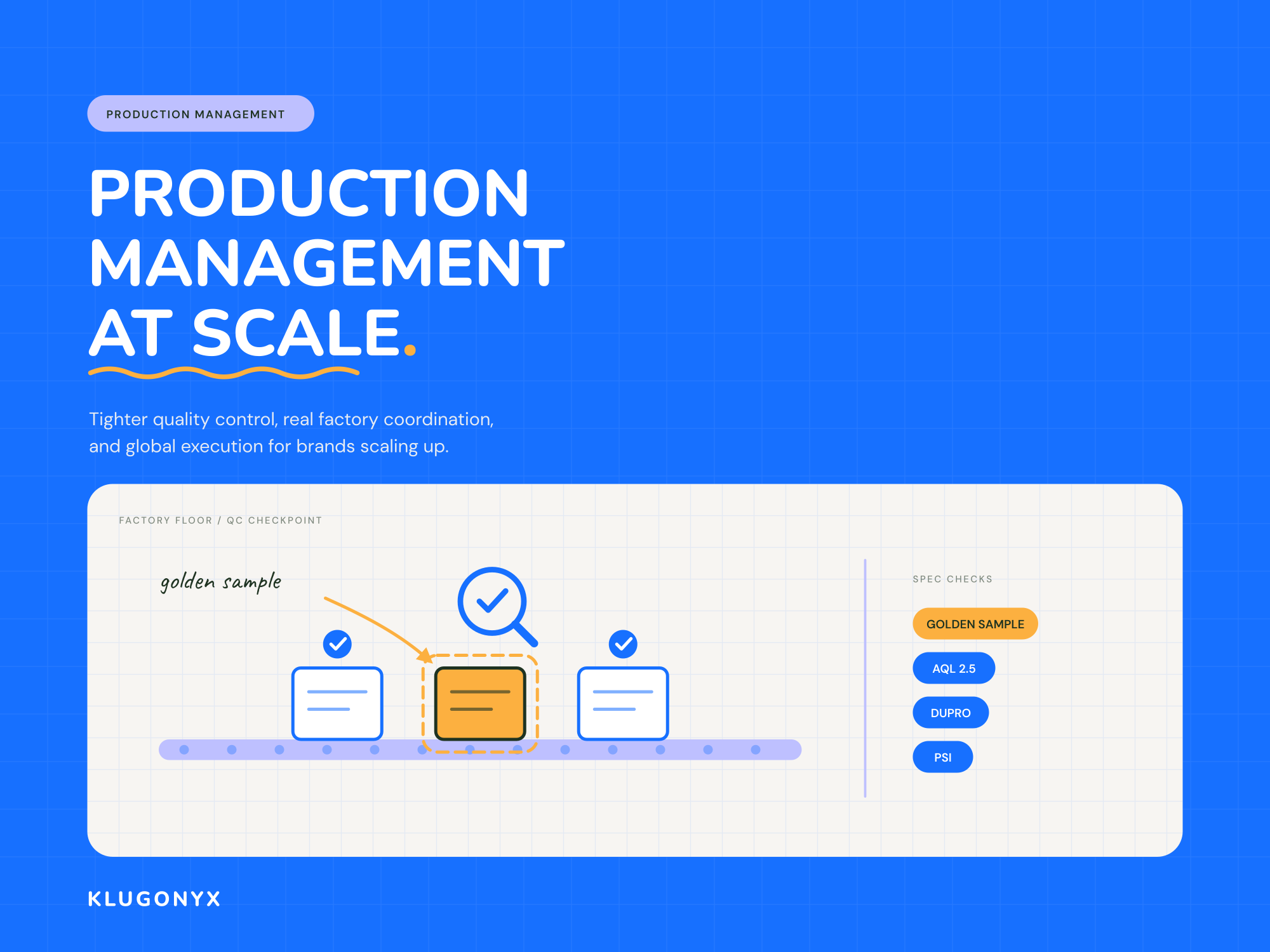
Before you commit to a full first production run, you will almost always go through multiple rounds of samples and, if your product requires it, you will pay for tooling or molds. A strong manufacturing checklist reminds you that sampling is not a single event. You will likely start with an initial sample, refine it into a revised sample, and ultimately approve a pre production or golden sample that becomes the standard for production.
You should be clear about what you will evaluate on each sample, including dimensions, fit, finish, function, and packaging. If your product requires tooling, you should have at least a rough understanding of typical tooling costs in your category and know who owns that tooling if you ever change factories. If you skip this thinking, you can easily end up with surprise tooling bills or a pre production sample that does not match your expectations, without a clear path to fix it.
7. Quality, Testing, and Compliance: Not a Later Problem
Quality and testing are often treated as something that can be addressed after production, but that approach is almost always more expensive. Before your first production run, you should document key specifications and tolerances, such as measurements, materials, colors, and finishes. You should decide what level of defects you can accept and what you will never accept under any circumstances.
If your product lives in a sensitive category such as baby, children, pet, wellness, or electrical products, you should already know which safety tests or certifications are likely to be required. You should also have a plan for pre shipment inspections and possibly in line inspections, and you should know who is going to carry those out. The goal is not to eliminate all risk but to ensure that quality, testing, and compliance are baked into your production ready checklist rather than bolted on at the end.
8. Orders, Terms, and Logistics: Are You Clear on How This Will Move
Even if you have a great factory, a project can fall apart if basic logistics and terms are not clear. Before you issue a purchase order, your first production run checklist should confirm that you understand and are comfortable with standard payment terms, such as thirty seventy or twenty eighty, and that you know which Incoterms you prefer, for example FOB, EXW, or CIF, and what those terms mean in practice.
You should have a general timeline mapped out from purchase order to production to inspection to shipping to arrival at your warehouse, fulfillment center, or retailer. You should decide whether you plan to ship by air, by sea, or through a mix, and you should be aware of major seasonal slowdowns such as Chinese New Year that could affect your schedule. You do not need to be a logistics expert, but you do need a realistic plan.
9. Risk, Intellectual Property, and Communication: Who Is Steering the Ship
Finally, a production ready approach requires you to think about risk and communication. You should identify the biggest risks for this first run, whether they relate to capacity, quality, delays, tariffs, or something else, and consider what your backup plan would be if the first factory does not work out. You should have agreements or confidentiality language in place before you share sensitive designs, recognizing that contracts reduce but do not completely remove risk around intellectual property.
You should also be clear about who on your team owns the relationship with the factory, who has authority to approve changes, and how often you will check in during development and production. Even a simple rhythm of regular updates can prevent small issues from turning into large surprises.
How to Use the Factory Sourcing Checklist With Your Team
The purpose of a factory sourcing checklist is not to slow you down or create busywork. It is to prevent you from skipping the steps that matter most. One effective way to use it is to run through the checklist on your own first and mark each item as ready, in progress, or not started. This gives you an honest snapshot of your production readiness.
Next, share the completed production ready checklist with your co founders or team leads so everyone has a shared understanding of where the project really stands. If you decide to work with a partner such as Klugonyx, sharing this document gives us a fast and accurate picture of what is in place and where you need help, whether that is product design, engineering, factory sourcing, or quality control. You can also reuse the same first production run checklist whenever you switch factories, move a product to a new country, or scale from small runs to much larger orders. Over time, it becomes a living manufacturing checklist that supports each major production change.
Download the Factory Sourcing and First Production Run Checklist
If you have made it this far, you are clearly serious about getting your first production run right. Instead of trying to recreate this framework in a notebook or a random spreadsheet, you can use a ready to go version that already reflects the key steps.
Download the Factory Sourcing and First Production Run Checklist and use this free, practical tool to see whether your product is truly production ready. It will help you prepare for factory sourcing, quality, and logistics before you place your first purchase order and give you a much clearer idea of what comes next.
If you fill out the checklist and discover more gaps than you expected, that is completely normal. Klugonyx works with brands every day to close those gaps, connecting product design, engineering, factory sourcing, and global manufacturing into one clear process. When you are ready, we are here to help you move from idea to in production with far fewer surprises.