How to Protect Your Product Design Before You Start Production
It is one of the most common fears in product development.
You finally have a product idea. You share it with a factory. Then the question hits you. What if they steal it?
That fear is understandable. It is also worth answering honestly.
Yes, product copying can happen. But most founders focus on the wrong thing. They think one patent or one NDA solves the problem. It does not.
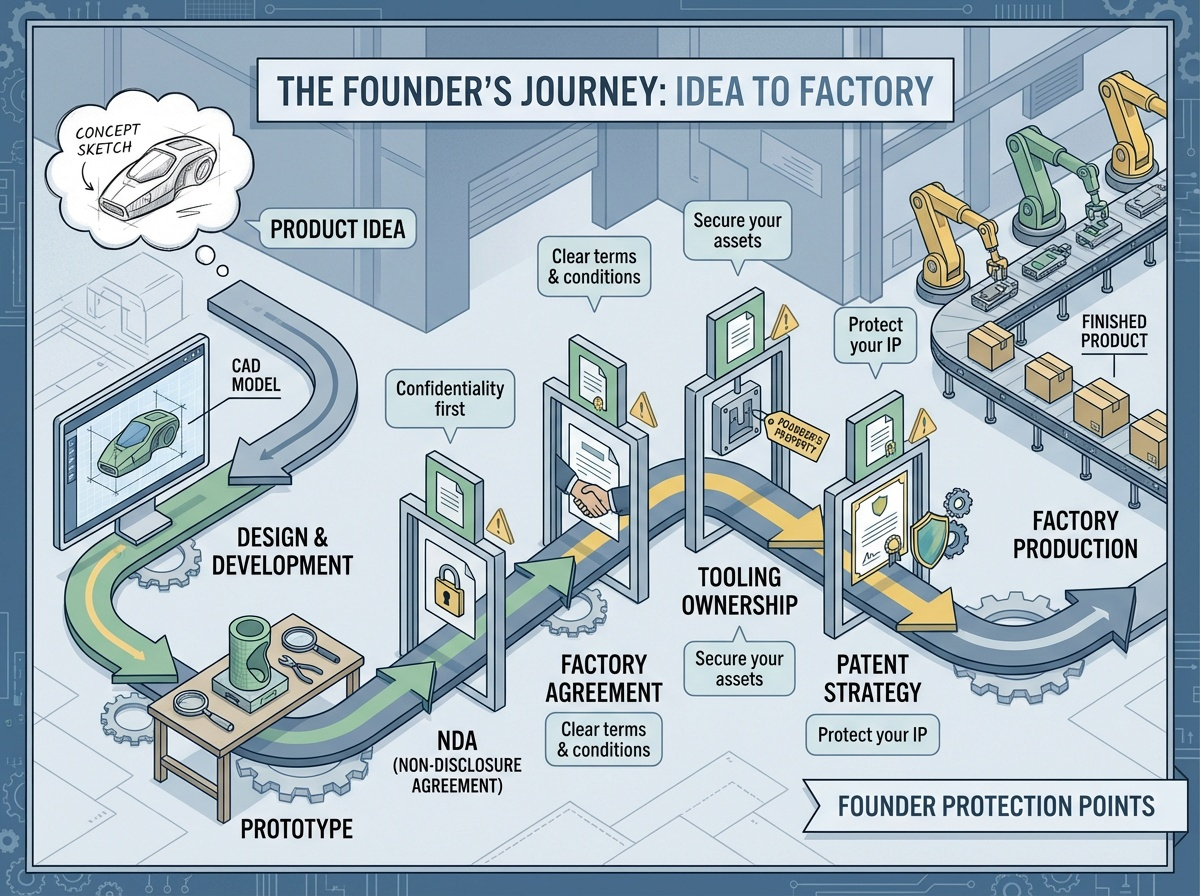
Real protection comes from a stack of decisions. It comes from what you disclose, when you disclose it, what contract you use, who owns the tooling, how complete your documentation is, and whether your IP is actually registered in the countries where you plan to manufacture and sell.
This is not legal advice. It is practical, experience-based guidance on how founders can reduce risk before production begins.
Yes, a Factory Can Copy a Product
A factory can copy a product if it has the information, sees commercial value, and believes the legal or practical risk is low. That is true in China, Vietnam, the United States, or anywhere else.
The bigger issue is not geography alone. The bigger issue is leverage and preparation.
If a founder shares full CAD, tech packs, BOMs, material specs, and supplier details too early, without the right agreements and controls, the factory has everything it needs to build the product. That is why strong documentation matters. As we explain in What Is a Tech Pack?, a tech pack is the manufacturing blueprint that tells a factory exactly how to build your product.
That is why good product protection starts before the first quote.
What Klugonyx Believes Before Production Starts
At Klugonyx, the goal is not to scare founders. It is to help them enter manufacturing with better structure.
In practice, that means sharing only what is necessary at each stage, using the right agreement before sensitive disclosure, making tooling ownership clear in writing, keeping control of complete product documentation, sourcing with factories that fit the product and the program, and registering key IP in the countries that matter to you.
Our product engineering services focus on detailed documentation, BOMs, tolerances, and DFM so factories can quote and build from clear instructions rather than guesswork. That improves quality and speed, but it also means your documentation itself is valuable and should be handled carefully.
An NDA Helps, but it is Not Enough
A lot of founders ask for an NDA and assume they are covered.
That is too optimistic.
A standard NDA focuses on confidentiality. In many overseas manufacturing situations, especially in China, lawyers often recommend a stronger NNN structure instead of relying only on a basic U.S.-style NDA.
NNN stands for non-disclosure, non-use, and non-circumvention. The reason is simple. You are not only trying to stop a factory from sharing your information. You are also trying to stop it from using that information for itself or going around you to reach your customers, supply chain, or market. Harris Sliwoski’s explanation of China NNN agreements is a useful overview of why that distinction matters.
That does not mean every factory relationship requires the exact same agreement. It does mean founders should understand that confidentiality alone is often too narrow.
A good overseas factory agreement should make clear what information is confidential, what the factory can and cannot use it for, whether it can make similar goods for itself or others, whether it can contact your customers or suppliers directly, which legal entity is signing the contract, and what language, court, and enforcement terms apply.
Factory Agreements Matter More than Most Founders Think
The NDA or NNN is only one layer.
The manufacturing or factory agreement is the bigger operating document. This is where you set the rules for how the relationship works once sampling, tooling, and production begin.
A strong factory agreement should clearly cover ownership of designs, drawings, and tech packs. It should also cover ownership of molds, tooling, jigs, and fixtures. It should address whether the factory can use your product, parts, or documentation outside your program. It should also set expectations around quality standards, inspection rights, approved materials, approved subcontractors, and what happens if the factory misses quality or timing targets.
This is where founders often get sloppy. They focus on unit cost and lead time, but skip ownership language. That is how expensive misunderstandings happen later.
Tooling Ownership is Not a Small Detail
If you pay for tooling, you should not assume you automatically control it.
That needs to be stated clearly.
For many hard goods programs, molds are one of the most important control points in the whole project. If the factory controls the mold and the agreement is vague, moving the program later can become difficult even if you paid for the tool.
This is one reason why design for manufacturing matters so much. The better defined your product is before tooling starts, the easier it is to document ownership, use rights, and transfer terms in a way that protects your leverage.
Patents Help, but They Do Not Do Everything
Patents can be powerful, but founders often expect too much from them.
Here is the honest version.
A patent does not create global protection. Patent rights are territorial. If you want protection in China or Vietnam, your filing strategy needs to reach those countries through the proper legal path. The China National Intellectual Property Administration is China’s official patent authority, and the World Intellectual Property Organization’s Vietnam IP materials are a useful reference point for understanding how national systems work.
That matters because many founders file only in their home market and assume that is enough. It often is not.
China also operates under a first-to-file system for patents and trademarks. That is one reason early filing matters. The China-Britain Business Council’s overview of protecting IP in China explains that point in plain language.
Patents can help stop copying when the right patent exists, when it covers what makes your product distinct, when it is filed in the right country, and when you are willing to enforce it.
But patents do not stop careless disclosure. They do not replace factory contracts. They do not protect everything valuable about a product. In many consumer products, brand, speed, sourcing control, tooling control, and trade secret protection matter just as much.
Trade Secrets Matter More than Many Founders Realize
Not every advantage belongs in a patent.
Trade secrets can include formulas, processes, specifications, supplier information, cost structures, and other confidential business information that creates value because it is not public.
In practical terms, that means one of the smartest things a founder can do is decide what really needs to be shared with the factory and what should remain compartmentalized.
That is one reason we push clients toward strong documentation and structured handoff through our product design services and product engineering services before production begins.
What You Should do Before Sharing Your Full Design
Before production starts, founders should usually have a basic protection stack in place.
Start with clear documentation. Your tech pack, drawings, BOM, and specifications should clearly show what is yours and what the factory is being asked to build.
Next, use the right agreement before deep disclosure. That may be an NDA, but in many overseas situations it may need broader non-use and non-circumvention language like the NNN structure described here.
Then put a factory agreement in place before tooling and production. This is where ownership, tooling rights, quality standards, and use restrictions need to be stated clearly.
You should also match your IP filings to your real markets and manufacturing countries. If China or Vietnam matters, your strategy should reflect that. The CNIPA and WIPO’s legal resources on Vietnam both reinforce that these are national legal systems, not extensions of your home country filings.
Finally, build a sourcing strategy instead of chasing one cheap quote. Our article on product sourcing for entrepreneurs explains how supplier fit affects not only price, but also risk, quality, and long-term control.
If you are manufacturing in Asia, it also helps to understand the bigger supply chain picture. You can explore our China sourcing and manufacturing page for more background, or review our China manufacturing alternatives guide if you are comparing regions.
Does Klugonyx Own Your Product Design?
The practical answer should be no, unless your agreement says otherwise.
A good development partner should be transparent about ownership. Founders should always know who owns the product design files, CAD, tech packs, artwork, tooling, and final production documentation.
Klugonyx positions itself as a partner that helps clients move from concept to production-ready files and manufacturing support through services like design, engineering, and broader supply chain development. But founders should always confirm ownership terms in the actual contract, not rely on assumptions.
Practical Protection Beats False Confidence
A lot of founders want a simple answer.
Should I trust the factory?
That is usually the wrong question.
The better question is this: have you built enough structure around the relationship that trust is not the only thing protecting you?
That structure includes better documentation, smarter sourcing, stronger agreements, clear tooling ownership, thoughtful disclosure timing, and real IP planning in the countries that matter.
This is also where DFM and complete factory-ready files matter. The more ambiguity you remove early, the fewer gaps there are later for disputes, misunderstandings, or misuse.
Final Thoughts
Can a factory steal a product design?
Yes. That risk is real.
But the better question is this: how easy are you making it?
Most product protection failures happen before the first production run. They happen when founders disclose too much, too early, with weak paperwork and unclear ownership terms.
Patents matter. Contracts matter. Tooling ownership matters. Documentation control matters. Factory selection matters.
The goal is not perfect safety. The goal is smart leverage.
If you want help building a product development process that protects your design while still getting you ready for real manufacturing, contact Klugonyx.
FAQ - Will a Factory Steal My Design
What is the minimum IP protection I should have before production starts?
At a minimum, you should have clear documentation, a signed confidentiality and non-use agreement before deep disclosure, and a factory agreement that clearly states who owns the design files, tooling, and production documentation. If you expect manufacturing or enforcement in China or Vietnam, your filing strategy should also account for those countries because IP rights are territorial. The CNIPA and WIPO’s Vietnam legal resources are good reminders that protection depends on the country where you want rights.
Does Klugonyx own any rights to my product designs?
That should depend on your contract, not assumptions. Klugonyx publicly presents itself as a client partner for design, engineering, and manufacturing support, but ownership terms should always be confirmed in writing in the actual agreement.
Can a Chinese factory legally copy my product?
If you do not have enforceable rights or contract restrictions in place, stopping copying becomes much harder. China has its own patent and IP system, but those rights depend on what you actually filed and what agreements you signed. China’s first-to-file structure also makes early filing important, as explained in this overview on protecting intellectual property in China.
What should be in an NDA with an overseas factory?
At a minimum, it should define confidential information, restrict disclosure, restrict use of the information for any purpose other than your project, and address non-circumvention where relevant. In China-related manufacturing, many practitioners recommend broader NNN-style protections instead of relying only on a standard NDA.
Will a patent protect my product in China or Vietnam?
Only if your patent strategy actually reaches those countries through the correct filing route. Patent protection is territorial, not automatic worldwide. China and Vietnam each have their own legal systems for patents and related IP rights. You can review the official CNIPA site for China and WIPO’s Vietnam legal materials for a starting point on Vietnam.