The First-Year Budget Framework for New Product Brand (Using a Silicone Baby Teether as the Real-World Example)
Quick answer: A realistic first-year budget for a new physical product brand runs roughly $40,000 to $115,000 all-in for a single SKU sold in the U.S. The product itself is cheap to make. The seven cost buckets around it (design, tooling, compliance testing, inventory, packaging, freight and duties, and go-to-market) are what actually consume the budget, and professional design and engineering is a bigger line item than most founders expect. Most guides only cover two or three of these buckets, which is why so many brands run out of money before their second production run.
Most budget guides for new product brands stop at the prototype. They walk you through sketches, a 3D-printed sample, maybe a mold quote, and then they wave goodbye right at the moment the hard math begins. That is the moment your money actually starts leaving the building.
This is a full first-year budget framework for a product brand that is just starting out, built around one concrete example: a silicone baby teether sold direct-to-consumer and on Amazon. We chose that product on purpose. Teethers are deceptively simple to look at and brutally regulated to sell, which makes them a perfect teacher. By the end, you will have a realistic budget range and, more importantly, a way of thinking you can apply to whatever you are building.
One caveat up front, and it matters: a silicone teether is not a Bluetooth speaker, a cosmetic, or a piece of apparel. Numbers shift dramatically across categories. We flag exactly where and why throughout, so you can adapt the framework to your own product instead of copying ours.
What does a realistic first-year budget look like for a new product brand?
For a single-SKU silicone baby teether launched in the United States, a realistic all-in first-year budget runs roughly $40,000 to $115,000, depending on order volume, packaging ambition, and how aggressively you market. The spread is wide because the biggest variables, inventory depth and ad spend, are the ones founders control most directly. Design, engineering, tooling, testing, and compliance form a largely fixed floor of roughly $16,000 to $30,000 that you pay regardless of how many units you make.
That number surprises people because the teether itself costs cents to mold. The product is cheap. The business around the product is not. Here is where every dollar actually goes.
The seven cost buckets in a product brand budget
Think of your first year in seven buckets, in roughly the order you will spend on them:
- Design and engineering
- Tooling and prototyping
- Compliance and safety testing
- The first production run (your inventory)
- Packaging and branding
- Freight, duties, and logistics
- Go-to-market (marketing, platform fees, operations)
A budget that accounts for only one or two of these is the single most common reason new brands run out of runway before their second production run. Let's price each one with the teether as our guide.
Bucket 1: Design and engineering
If you already have a finished, manufacturable CAD file, you can skip most of this. If you are starting from a sketch or a napkin idea, this is where the real work begins, and it is almost always more than founders expect.
Most budget guides quote a CAD file at a few hundred dollars. That figure describes a solo freelancer redrawing an existing shape, not the actual work of taking a product from concept to a file a factory can tool from. Real product development runs in two phases, and both take serious hours.
First comes design: the form, the ergonomics, the sensory texture, the way the shape reads on a shelf. For a teether, the design team typically spends 50 to 60 hours getting this right, at roughly $150 per hour. That is about $7,500 to $9,000.
Then comes engineering, which turns that design into something that can actually be molded and pass safety geometry. For a teether, engineering runs 30 to 50 hours at roughly $195 per hour, or about $5,850 to $9,750. This is where draft angles, wall thickness, parting lines, and the domed-end performance rules get solved before any steel is cut.
Realistic design and engineering: $13,000 to $19,000. A flat, single-color shape sits at the low end. A multi-color, texture-rich, ergonomically considered piece sits at the high end. It is tempting to flinch at this number, but it is also the cheapest place in the entire budget to catch problems. A solid design-for-manufacturing review here routinely saves far more than it costs in avoided re-tooling later.
A quick word on those rates, since they are higher than the freelance-marketplace figures floating around online. Marketplace listings of $25 to $50 an hour describe what an individual contractor earns, not what a full-service design and engineering firm bills for production-ready work. Established product design consultancies generally bill $150 to $200 per hour, more in major metros. Klugonyx rates sit squarely in that professional band: fair for full-service work, neither bargain-bin nor inflated. If a quote comes in dramatically below it, ask what is being left out, because the gap usually reappears later as failed tooling or a product that cannot pass testing.
Category note: a teether is mechanically simple. Electronics, textiles, and anything with moving parts take far more design and engineering time, which can multiply this bucket several times over.
Bucket 2: Tooling and prototyping
Tooling is the mold, and for most physical products it is your first big check.
For custom silicone, single-cavity molds usually cost between $400 and $4,000, while multi-cavity or complex tooling can range from $5,000 to $10,000 or more. Compression molds, common for lower-volume silicone runs, sit at the friendlier end, typically between roughly $700 and $3,500 per set with an 8 to 15 day lead time. Teether-specific quotes cluster tightly: the mold fee for a custom silicone teether is around $600 to $1,000.
Add a 3D-printed prototype before you commit to steel. It is a small spend that protects a much larger one. Budget a few hundred dollars for one or two prototype iterations.
Realistic tooling and prototyping: $700 to $4,000 for a straightforward single design, more if you launch several shapes or colors that each need their own tool.
Category note: plastic injection tooling for larger or higher-precision parts can run well past $10,000, and processes that need EDM (electrical discharge machining) cost more again. Silicone teethers are forgiving here. Many products are not.
Bucket 3: Compliance and safety testing (the bucket everyone underestimates)
Here is where the teether earns its place as our example. A teether is, by definition, a children's product intended for a child to put in their mouth. That triggers the full weight of U.S. children's product law, and there is no skipping it.
Under the Consumer Product Safety Improvement Act (CPSIA), children's products must comply with all applicable safety rules, be tested by a CPSC-accepted accredited laboratory, carry a written Children's Product Certificate (CPC), and have permanent tracking information affixed. Teethers fall under specific additional rules: certain teethers and teething toys must comply with 16 C.F.R. part 1510, and those with domed ends must meet additional performance requirements.
The certificate is not optional paperwork, and you cannot borrow your factory's. Testing in a non-accepted lab, or relying on a supplier's in-house reports, does not satisfy CPSIA requirements, and the U.S. importer of record carries legal liability even when testing happens overseas. The penalties are not symbolic: the CPSC can levy civil penalties of up to $120,000 per violation, capped at over $17 million for a related series of violations.
So what does testing actually cost? Most customers pay somewhere between $500 and $1,800 per product for CPSIA and ASTM F963 testing, with simpler products costing less. A simple silicone teether is about as simple as construction gets: one material, ideally one color, no batteries, no detachable small parts. That keeps you near the lower end. Broader industry estimates have long pegged fully compliant testing at roughly $300 to $4,000 per item, because each separate component, color, or material is treated as its own test. The lesson hiding in that range: every extra color and every extra material multiplies your testing bill. Design discipline is cost discipline.
Two more line items belong here. First, the certificate itself: if a service drafts your CPC, retail pricing sits around $350 per document. Second, a critical change for anyone importing in 2026 and beyond.
What is changing with product compliance in 2026?
Starting in mid-2026, the certificate stops being a file in your drawer and becomes data the government checks at the border before your goods land. Beginning July 8, 2026, importers of most regulated consumer products are required to electronically file (eFile) certificates of compliance with U.S. Customs and Border Protection through a Partner Government Agency Message Set. Practically, that means your compliance has to be airtight and audit-ready from day one, not patched together after customs flags you.
Realistic compliance and testing: $1,500 to $5,000 in year one, including testing, the certificate, tracking labels, and a buffer for a re-test if first samples fail any single check.
Category note: this bucket swings hardest by category. A general-use adult product that is not a children's product, not food-contact, and not electronic may need only a General Certificate of Conformity and far less testing. A teether sits near the strict end. For a deeper walkthrough specific to this category, see our guide on how to make safe baby products.
Bucket 4: Your first production run
This is usually the largest single check you write, and it is governed by one word: MOQ, the minimum order quantity.
For silicone teethers, MOQs depend on the mold, the factory, and one thing most guides leave out: your relationship with the supplier. You will see eye-catching low numbers advertised, an MOQ of 20 pieces on existing tooling, or 1,000 pieces on a new mold. Those are real, but they are usually best-case figures for returning, trusted customers or for off-the-shelf designs. As a first-time buyer with no track record, expect a factory to set a higher minimum to make a custom run worth their time. For a new silicone teether with its own tooling, a realistic first-order MOQ is closer to 3,000 units, sometimes more. Lower minimums tend to come later, once you have placed a few orders and proven you pay on time and reorder.
The per-unit manufacturing cost is genuinely tiny at the factory gate: silicone baby teethers cost a manufacturer roughly $0.50 to $5.00 each to make, with raw materials making up 40 to 60 percent of that. Even allowing for the factory's margin, your landed unit cost before freight and duty often sits in the low single digits of dollars.
Run the math on a realistic first order of 3,000 units. At a blended cost of $1.50 to $3.00 per finished, packaged unit, your production run is roughly $4,500 to $9,000. Commit to a larger first run of 5,000 units to chase a better per-unit price, and you are closer to $7,500 to $15,000.
Here is the strategic tension every founder faces. A higher MOQ lowers your unit cost but ties up cash and bets on demand you have not proven yet. You often cannot dodge it on a first custom run, so the smarter move is to negotiate hard on payment terms, validate demand before you order, and treat that first 3,000-unit commitment as the real cost of entry rather than assuming you can start with a few hundred pieces.
Realistic first production run: $4,500 to $15,000, driven mostly by your first-order MOQ and the per-unit price you negotiate.
Bucket 5: Packaging and branding
Packaging is where a teether stops being a molded blob and becomes a brand. For a baby product, packaging is also a trust signal: parents scan for safety cues, materials, and credibility in about three seconds.
Budget for structural packaging design, a barcode, and the printed materials themselves. A GS1 barcode is a small, non-negotiable line item: GS1 US offers a single UPC code for $30 with no annual fee, and Amazon now requires UPC codes to come from GS1 for brand-registered sellers. Professional creative (logo, packaging artwork, listing imagery) ranges widely. Across photography, graphic design, and market research, new sellers commonly spend anywhere from $200 to $5,000 or more.
Realistic packaging and branding: $1,500 to $8,000. The low end is a clean freelancer-designed box and a basic photo shoot. The high end buys a distinctive structural package, full brand identity, and lifestyle photography that earns a premium price.
Category note: if your product is fragile, oversized, or needs protective inserts, packaging cost and the freight that follows both climb.
Bucket 6: Freight, duties, and logistics
If you manufacture overseas, this bucket can quietly eat a tenth of your budget, and in 2026 it deserves extra attention.
Duties on China-origin goods stack in layers, and most first-time importers forget the layers. Total import cost combines a base duty rate, a Merchandise Processing Fee (about 0.3464 percent of declared value, minimum near $32), possibly a Harbor Maintenance Fee (0.125 percent of cargo value on ocean shipments), and potentially Section 301 tariffs that can add anywhere from 10 to over 100 percent on top.
The bigger story is policy volatility. The tariff structure you budget under today may not be the one in effect when your container lands. The 10 percent global tariff currently running under Section 122 is set to expire on July 24, 2026, and the administration has begun the process to replace it with Section 301 tariffs across dozens of countries. Section 301 is the durable one to plan around: unlike temporary measures, it carries no expiry date and no rate cap, and the original 2018 China tariffs are still in effect today.
This is the single strongest argument for thinking about where you manufacture before you fall in love with a quote. A China teether may carry a real duty load; a comparable unit from Vietnam or Mexico may not, and the gap can dwarf the per-unit savings China offered in the first place. If China is still your best option on quality or capability, a deliberate China Plus One strategy hedges the policy risk.
Realistic freight, duties, and logistics: $1,000 to $6,000 on a first run, scaling with order size and shipping mode. Air is fast and expensive; sea is cheap and slow.
Bucket 7: Go-to-market
You have a tested, compliant, beautifully packaged product sitting in a warehouse. Now you have to sell it, and selling costs money before it makes money.
If you sell on Amazon, budget for the platform itself. A professional Amazon seller account costs $39.99 per month, which pays for itself once you sell more than 40 items a month. Then there is advertising, where go-to-market budgets balloon. New sellers frequently model meaningful pay-per-click spend from day one because sales velocity drives ranking. One researched FBA model budgets a $10,000 first-year marketing budget, with PPC running around 40 percent of revenue and a $25 customer acquisition target.
Add the rest of the operating layer: a basic software stack, business registration and insurance, and a little professional help. A lean operating model can carry roughly $500 per month for professional services and $150 per month for business insurance, on top of software.
The honest range for launch budgets is wide because ambition varies. The average Amazon private label launch costs between $3,000 and $10,000 depending on niche and strategy. Some founders launch leaner and reinvest profit; others fund aggressively to buy speed.
Realistic go-to-market: $5,000 to $20,000+ in year one, dominated by ad spend and inventory replenishment.
The full first-year teether budget
Here is the whole picture for a single-SKU silicone baby teether, U.S. market, sold direct-to-consumer and on Amazon.
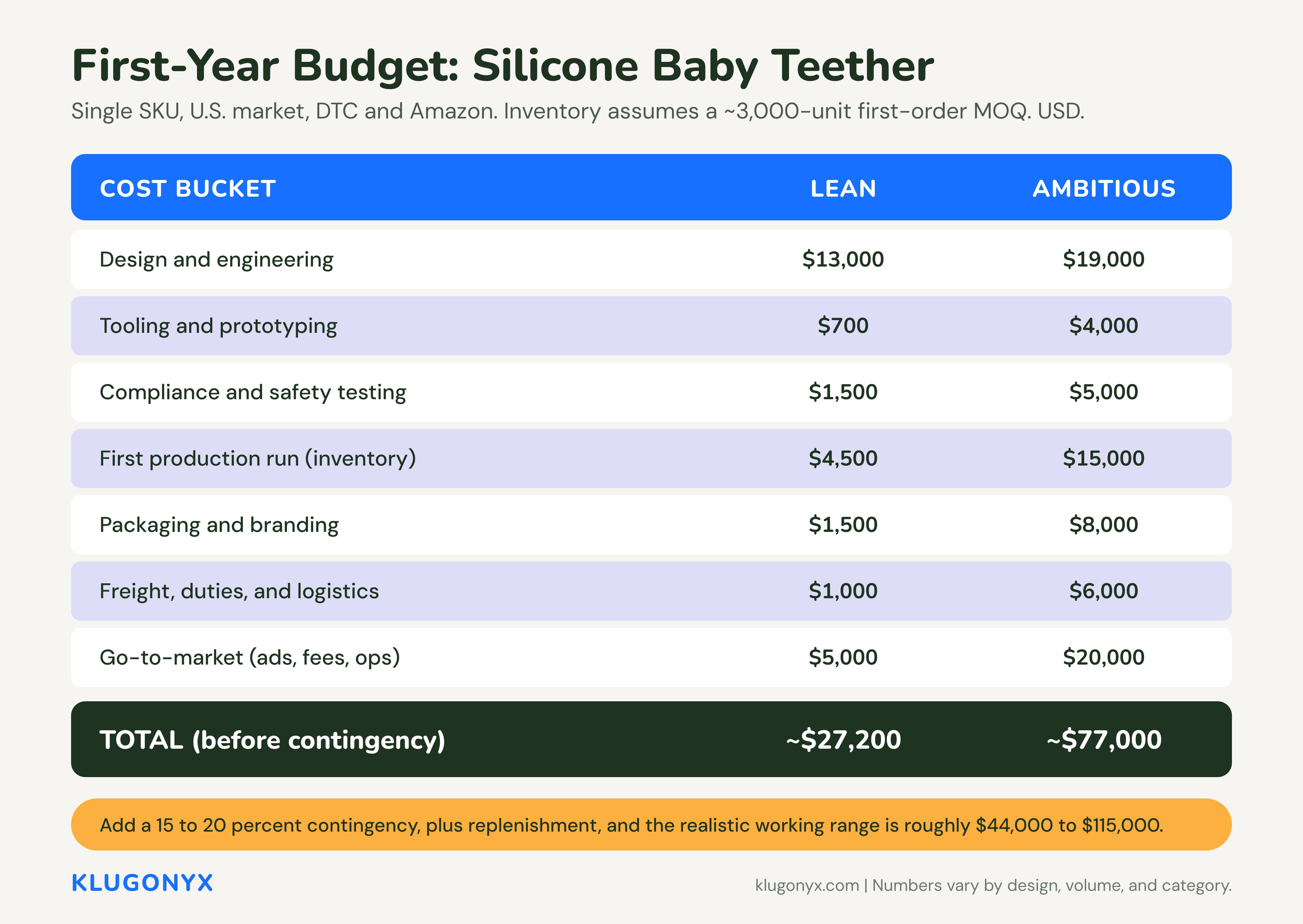
Build in a contingency buffer of 15 to 20 percent, because something always costs more than the quote, then account for replenishment and a likely second production run inside the same twelve months. That is how you arrive at the $44,000 to $115,000 realistic working range we opened with.
The shape of that table is the real takeaway. The molded silicone itself is almost a rounding error. The design, engineering, and compliance work that makes it sellable, plus the marketing that makes it visible, is the actual cost. Brands that survive their first year budget for all seven buckets, not the two or three that show up in most prototype-focused guides.
How other product categories change the math
The framework holds for any physical product. The numbers do not. Adjust along four axes:
- Regulatory load. A children's or food-contact product carries heavy mandatory testing. A general-use adult product often does not, which can cut your compliance bucket by 60 to 80 percent.
- Tooling complexity. Silicone compression molds are cheap. Multi-cavity plastic injection tooling, die-cast metal, or electronics enclosures can multiply Bucket 2 many times over.
- Bill of materials. A teether is one material. A product with a dozen components, a battery, or printed circuitry raises unit cost, testing cost, and assembly cost at the same time.
- Unit economics and price point. A premium product can absorb higher per-unit cost and fund more aggressive marketing. A commodity item lives or dies on volume and freight efficiency.
Map your product onto those four axes and you can re-price every bucket above with reasonable confidence.
Frequently asked questions
How much does it cost to start a product brand?
For a simple single-SKU physical product sold in the U.S., a realistic first-year budget runs roughly $44,000 to $115,000 all-in. Professional design and engineering, plus tooling, testing, and compliance, form a largely fixed floor of about $16,000 to $30,000; the rest is driven by inventory depth and marketing spend, which the founder controls.
How much does it cost to make a silicone baby teether?
At the factory, very little. Manufacturing cost is roughly $0.50 to $5.00 per unit before packaging, and tooling for a custom teether mold typically runs $600 to $1,000. The real cost is everything around the unit: safety testing, certification, packaging, freight, duties, and marketing.
Do I have to safety test a baby teether before selling it in the U.S.?
Yes. A teether is a children's product under the CPSIA, so it must be tested at a CPSC-accepted third-party lab, carry a Children's Product Certificate, and have permanent tracking information. As the importer, you hold legal liability even if an overseas factory did the testing. Budget roughly $1,500 to $5,000 for testing and certification.
What is the minimum order quantity for a custom silicone product?
It depends on the mold and on your relationship with the factory. Advertised minimums can be very low, around 20 units on a manufacturer's existing tooling, but those are usually reserved for trusted, returning customers. As a first-time buyer opening a new custom mold, expect a higher minimum, often around 3,000 units, so the factory's setup is worth their time. Lower MOQs typically come later, once you have a track record with the supplier.
Why is my product cheap to manufacture but expensive to launch?
Because the unit is only one of seven cost buckets. Professional design and engineering often costs more than the entire first production run, and compliance, packaging, freight and duties, and go-to-market all sit between a molded part and a sold product. Most first-year budgets are dominated by design, engineering, inventory, and marketing, not by the per-unit cost of the product itself.
How do tariffs affect my product budget in 2026?
Significantly, and unpredictably. China-origin goods can carry stacked duties well above the headline rate, and the policy is shifting fast in 2026 as temporary tariffs expire and Section 301 actions expand. Model your specific tariff code with a customs broker, and weigh sourcing alternatives, before committing.
The bottom line
A great product idea dies more often from a budget that stopped at the prototype than from a bad design. Price all seven buckets. Treat compliance as a real line item, not an afterthought. Treat sourcing and tariffs as a strategic decision rather than a quote to rubber-stamp. Do that, and your first production run becomes the start of a business instead of the end of your savings.
Klugonyx helps founders turn an idea into a market-ready product across design, engineering, compliance, and manufacturing, with a factory partner network built for exactly this kind of launch. If you want a realistic budget and timeline for your specific product, let's talk.