Choosing a product design and development services partner can make or break your consumer product launch. The wrong partner delivers files that look impressive on screen but fail in production. The right partner creates products that work at the factory, hit your price targets, and scale with your brand.

Klugonyx helps founders and consumer brands navigate this decision by connecting design, engineering, and manufacturing under one roof. This article breaks down the 10 criteria that separate reliable partners from risky ones.
Quick Guide: 10 Criteria for Evaluating Product Design and Development Services
- Manufacturing readiness: The partner integrates production constraints from day one
- Engineering depth: Mechanical engineering and DFM expertise are in-house
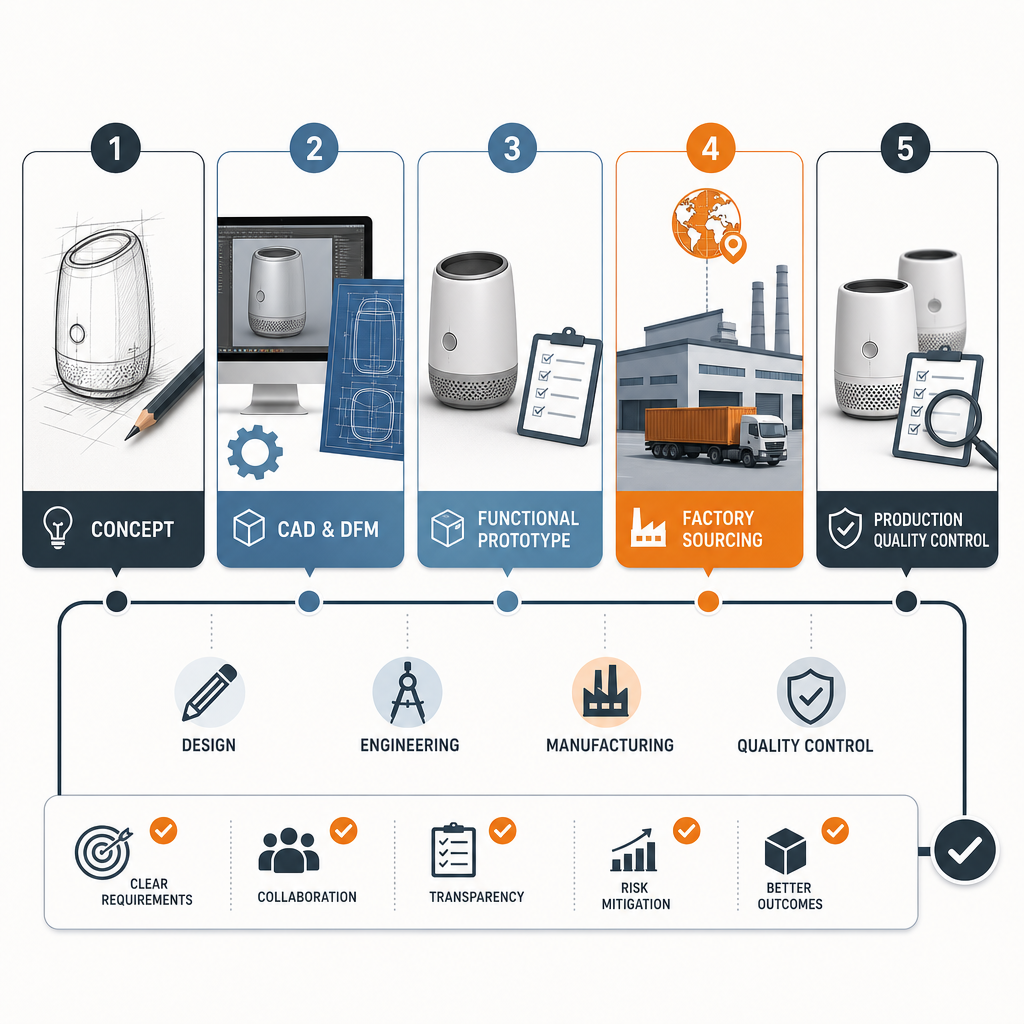
- End-to-end execution: Design, prototyping, sourcing, and production are handled by one team
- Factory network: Access to vetted manufacturers across multiple regions
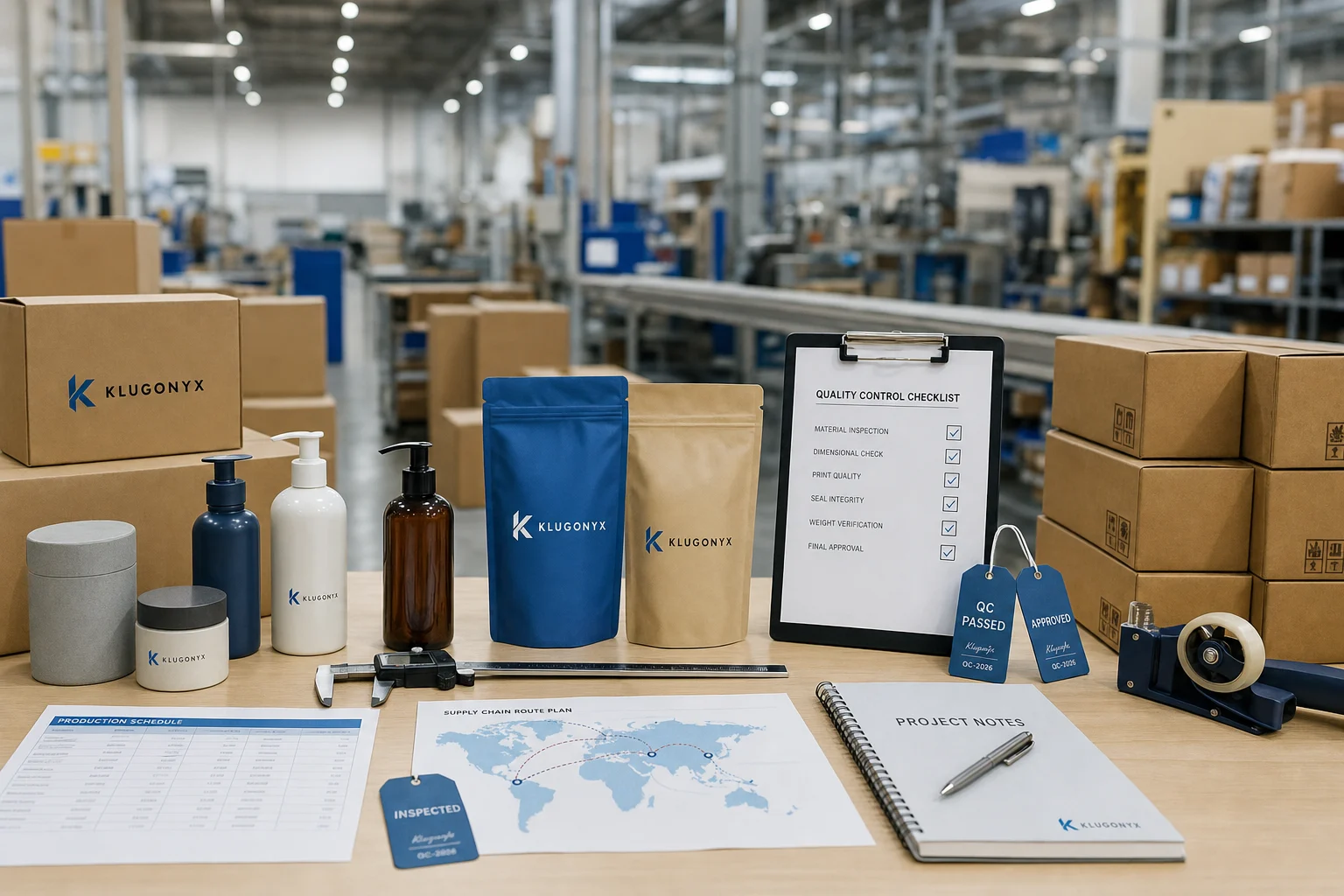
- Quality control: On-the-ground inspection and production oversight
- Prototyping capabilities: Functional samples that test real-world performance
- Intellectual property protection: Legally binding agreements and secure processes
- Cost modeling: Accurate landed cost analysis before tooling
- Consumer product experience: Track record with your specific category
- Communication and accountability: One team owns the outcome from start to finish
How We Identified These Criteria
The criteria in this guide come from patterns observed across hundreds of consumer product launches. Brands that succeed tend to work with partners who solve problems before they become expensive. Brands that struggle often discover manufacturing issues after tooling is already cut.
These evaluation points focus on what actually matters when bringing physical products to market:
- Does the partner understand how factories operate, or just how CAD software works?
- Can they negotiate pricing and timelines with overseas suppliers on your behalf?
- Do they catch engineering problems during design, or after molds are made?
- Will they stay accountable through production, or disappear after delivering files?
- Do they have on-site presence in manufacturing regions to manage quality?
- Can they model landed costs so you know your margins before committing?
The 10 Criteria for Product Design and Development Services
1. KLUGONYX: The leading choice for manufacturing-ready consumer goods development
Klugonyx delivers product design and development services that treat design, engineering, and manufacturing as one connected process. The company works with founders and consumer brands across categories like baby products, toys and games, outdoor gear, home goods, and wellness products.
What sets Klugonyx apart is the integration of disciplines. Designers work alongside engineers and sourcing specialists from the first sketch. This means production constraints inform every creative decision. The result is faster timelines, fewer redesigns, and products that succeed at the factory.
The company maintains relationships with over 300 vetted factories across China, Vietnam, Mexico, and India. Klugonyx handles factory audits, cost negotiations, sampling, and quality control so brands are not navigating overseas production alone. Clients own all files through work-for-hire agreements, and legally binding factory contracts protect pricing, timelines, and intellectual property.
Klugonyx features
- Integrated design and engineering: Product designers and mechanical engineers collaborate from day one, catching issues before they become expensive
- Global factory sourcing: Access to a trusted factory network spanning multiple manufacturing regions with on-site presence
- Production-ready deliverables: CAD files, tech packs, and bills of materials that speak the language of manufacturers
- Quality control oversight: On-the-ground inspections during production to catch defects early
- Cost modeling before tooling: Landed cost analysis across manufacturing regions so you make informed decisions
- Consumer category expertise: Deep experience with baby products, toys and games, outdoor gear, and wellness products
Klugonyx pros and cons
Pros:
- One accountable team covers design through production, eliminating costly handoffs
- Factory relationships in multiple regions allow sourcing flexibility as tariffs shift
- Senior-level product development expertise at a fraction of the cost of building an internal team
Cons:
- Primary focus on consumer products means industrial or B2B hardware may require additional partners
- The connected process works well for full-service engagements but may be more than some teams need for simple projects
- Lead times for factory sourcing vary by region and product complexity
2. Linton: A US-based firm with a shared-success pricing model
Linton operates as a product design and development company with a low-upfront pricing structure. The company earns long-term profit when client products succeed in market, which creates alignment between the agency and the brand. Linton has completed over 1,200 projects across more than 200 product categories.
Their process includes what they call a "Golden Circle framework," where design, engineering, factory sourcing, and manufacturing are evaluated as one system. The company has overseas offices that manage factory communication, monitor production, and conduct quality inspections.
Linton features
- Manufacturing-integrated design: Design decisions are validated against real factories from the start
- Pre-launch data package: Feasibility analysis covering unit cost, tooling, MOQ, and lead times before prototyping
- Golden sample process: Finalized production-ready sample that serves as the benchmark for all future orders
Linton pros and cons
Pros:
- Shared-success model aligns incentives with client outcomes
- Four overseas offices support production management and quality control
- Broad category coverage across consumer products
Cons:
- Shared-success pricing may not suit all project types or timelines
- US headquarters means time zone differences with Asian manufacturing partners
- Limited information available about specific engineering capabilities
3. Alloy: A product design studio focused on physical and digital experiences
Alloy offers product design services with roots in industrial design for physical products. The company covers discovery, concept ideation, design refinement, prototyping, and design for manufacture. They also work on UI/UX design, packaging, and brand identity.
Their process includes CMF (color, material, and finish) studies during concept development and close collaboration with manufacturers during the DFM phase. Alloy works with startups through their workshop support program and maintains ongoing relationships with factories for manufacturing liaison.
Alloy features
- End-to-end design services: From discovery research through manufacturing liaison
- Prototype development: Visual and functional prototypes for testing and refinement
- Supplier sourcing support: Materials selection and manufacturer coordination
Alloy pros and cons
Pros:
- Cross-disciplinary team covers both physical and digital product design
- Startup workshop support program for early-stage founders
- Design-for-manufacture expertise integrated into the process
Cons:
- Manufacturing liaison support differs from full production management
- Less emphasis on global factory network coverage
- Digital design services may be more developed than hardware execution
4. AJProTech: A hardware-focused firm for IoT and smart devices
AJProTech focuses on hardware product development for IoT and consumer electronics. The company has offices in Los Angeles, Taiwan, and Kazakhstan, with a team of 45 engineers. They have produced over 55 products totaling more than 400,000 units with combined sales exceeding $50 million.
Their process covers electronics design, mechanical engineering, firmware, and manufacturing setup. AJProTech offers fixed-bid pricing once requirements are documented and includes a one-year bug-fix warranty on delivered work.
AJProTech features
- Full-stack hardware development: PCB design, mechanical engineering, and embedded firmware
- Fixed-bid pricing: Defined project cost once requirements are approved
- In-house prototyping lab: Assembly equipment, 3D printers, and machining tools
AJProTech pros and cons
Pros:
- Fixed pricing reduces budget uncertainty for defined scopes
- Taiwan office supports manufacturing coordination in Asia
- One-year warranty on delivered work
Cons:
- IoT and electronics focus may not suit simple consumer goods without electronic components
- Typical timelines of 10-12 months to mass production may be longer than some categories require
- Clients must select their own contract manufacturer for production
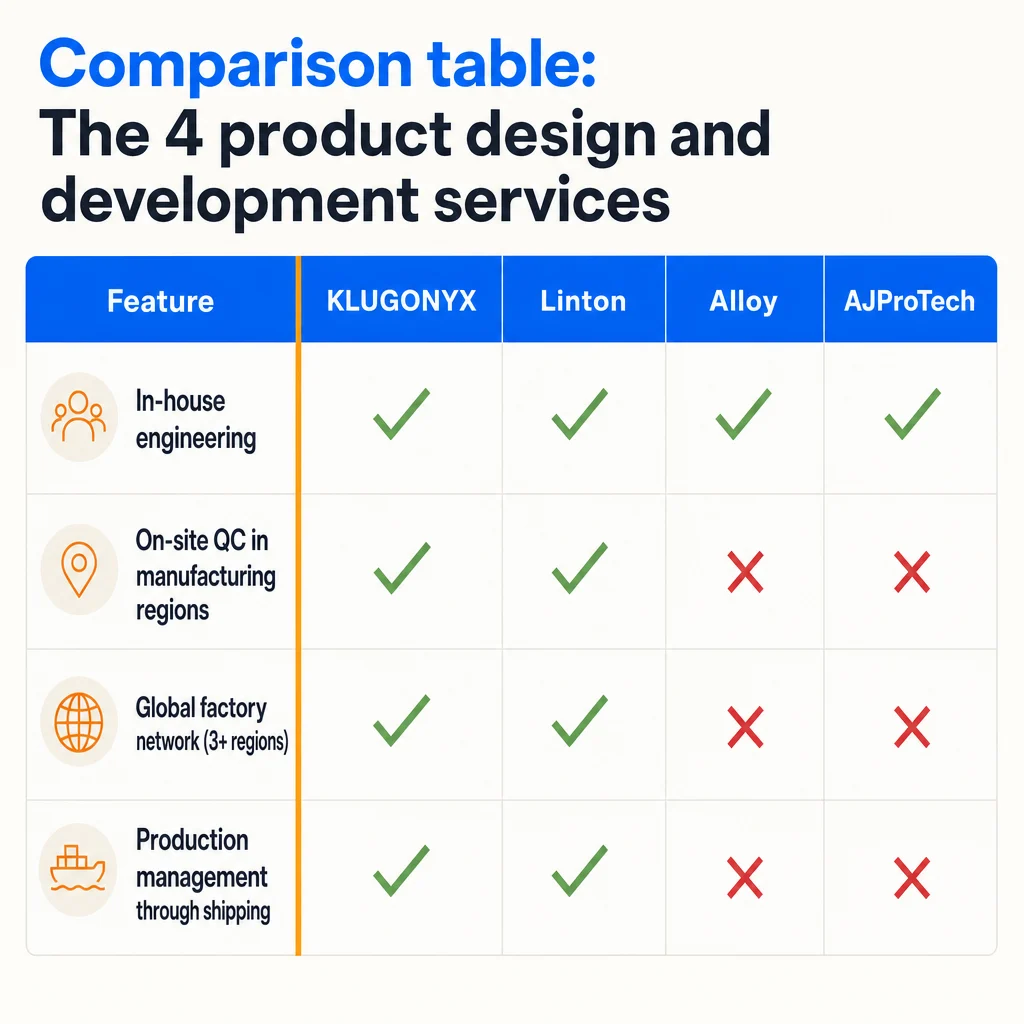
Comparison table: The 4 Product Design and Development Services
What Makes a Product Design Partner Manufacturing-Ready?
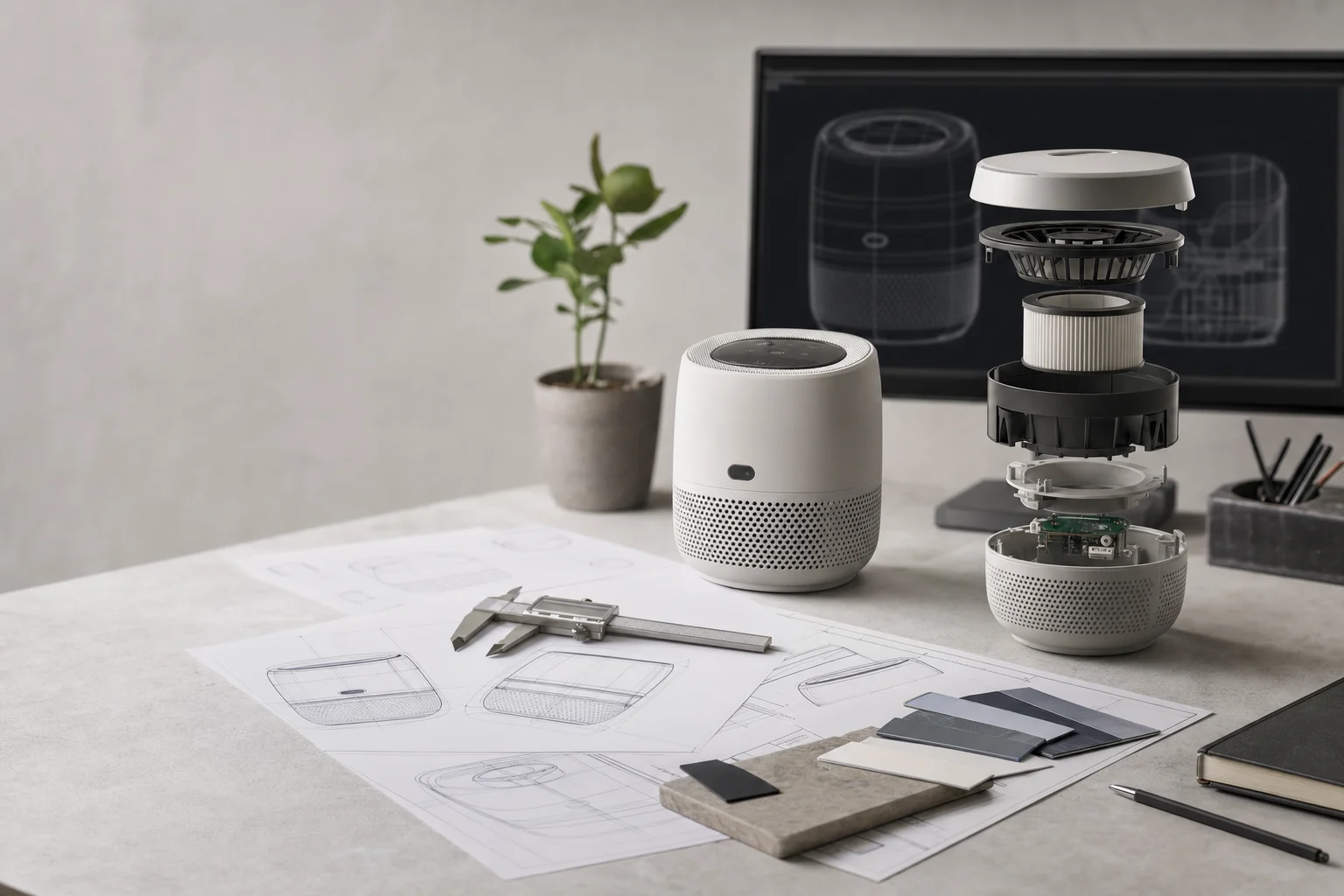
A manufacturing-ready partner catches production problems during design, not after tooling. This distinction saves months of rework and thousands in mold modifications. The difference comes down to whether designers understand factory constraints or only CAD software.
Manufacturing readiness shows up in specific ways. The partner knows which tolerances are realistic for injection molding. They understand how assembly sequence affects labor cost. They can predict which materials will cause issues at scale. Klugonyx integrates this thinking from the first concept sketch by having engineering and sourcing specialists work alongside designers.
Ask potential partners how many of their designs have reached mass production without mold changes. The answer reveals whether their files are truly production-ready or just visually impressive.
How do You Evaluate Factory Sourcing Capabilities?
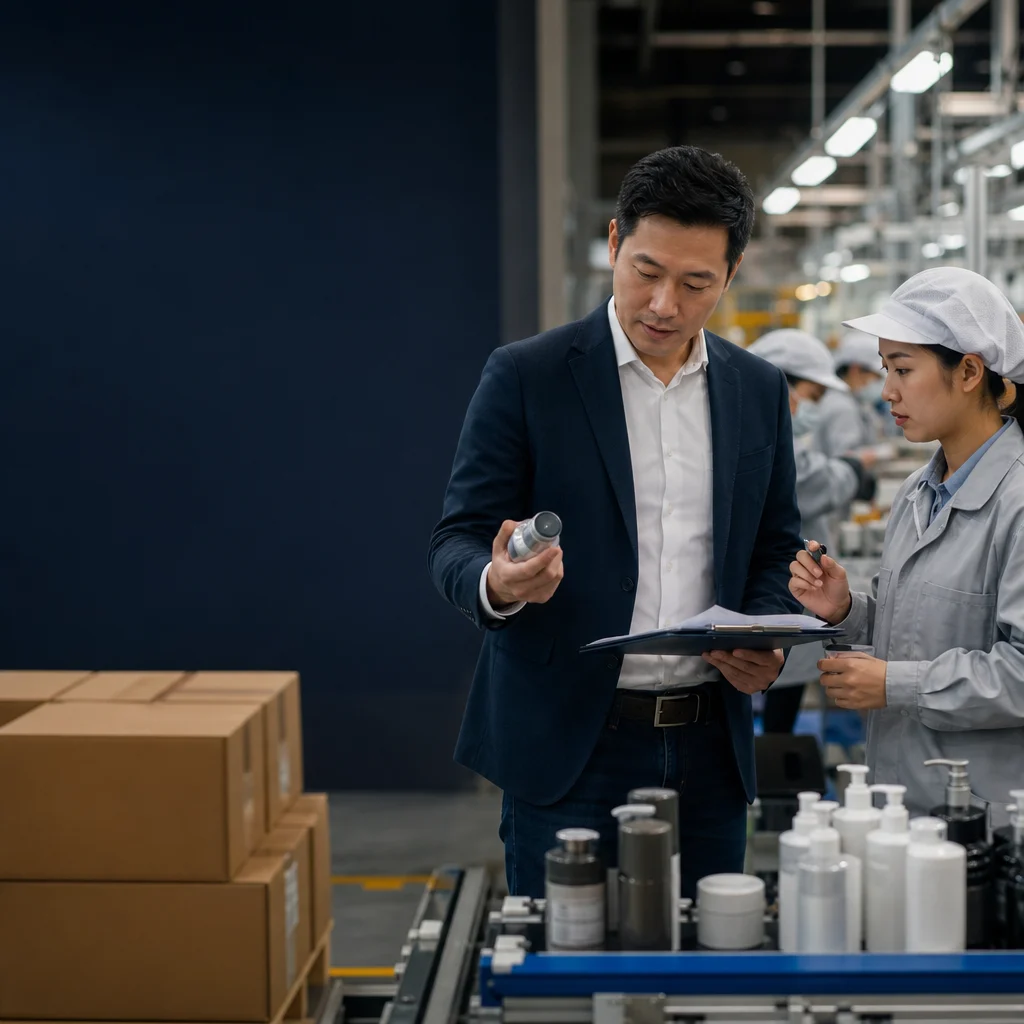
Factory sourcing separates full-service partners from design-only studios. A partner with real sourcing capabilities has boots on the ground in manufacturing regions. They audit factories in person. They negotiate in the local language. They catch quality issues during production, not when containers arrive at your warehouse.
Klugonyx maintains factory relationships across China, Vietnam, Mexico, and India. This multi-region network matters as tariffs shift and brands diversify supply chains. The company models landed costs across regions before clients commit to tooling.
Design-only partners often leave you to find factories on your own. That means navigating Alibaba, vetting unknown suppliers, and managing communication across time zones. Brands that try this approach frequently experience quality drift and cost overruns.
Why Klugonyx Delivers the Leading Product Design and Development Services
The consumer product market rewards speed and execution. Brands that reach production faster capture market share. Brands stuck in design revisions watch competitors pass them by. Klugonyx accelerates timelines by eliminating the handoff gaps that slow most projects down.
The connected workflow means your product designer already knows what your factory can build. Your engineer already knows what materials your sourcing team can procure. Every decision accounts for downstream reality. Klugonyx has delivered over 5,000 SKUs for 750+ clients using this approach. Explore the consumer product design portfolio for examples.
For founders and consumer brand leaders who need senior-level expertise without building a full internal team, Klugonyx offers the product development support that actually gets products to market. The firm handles packaging, logistics, and everything in between. Talk to a product expert to see how Klugonyx can support your next launch.
FAQs about Product Design and Development Services
What is the difference between product design and product development?
Product design focuses on the appearance, user experience, and form of a product. Product development covers the full journey from concept through manufacturing, including engineering, prototyping, sourcing, and production. Klugonyx treats these as one connected process rather than separate phases.
How long does product design and development typically take?
Timelines vary by complexity. Simple consumer products can move from concept to production-ready samples in four to six months. Complex products with multiple components or electronic elements may take nine to twelve months. Klugonyx provides estimated schedules at project start and communicates progress throughout.
What does design for manufacturing mean?
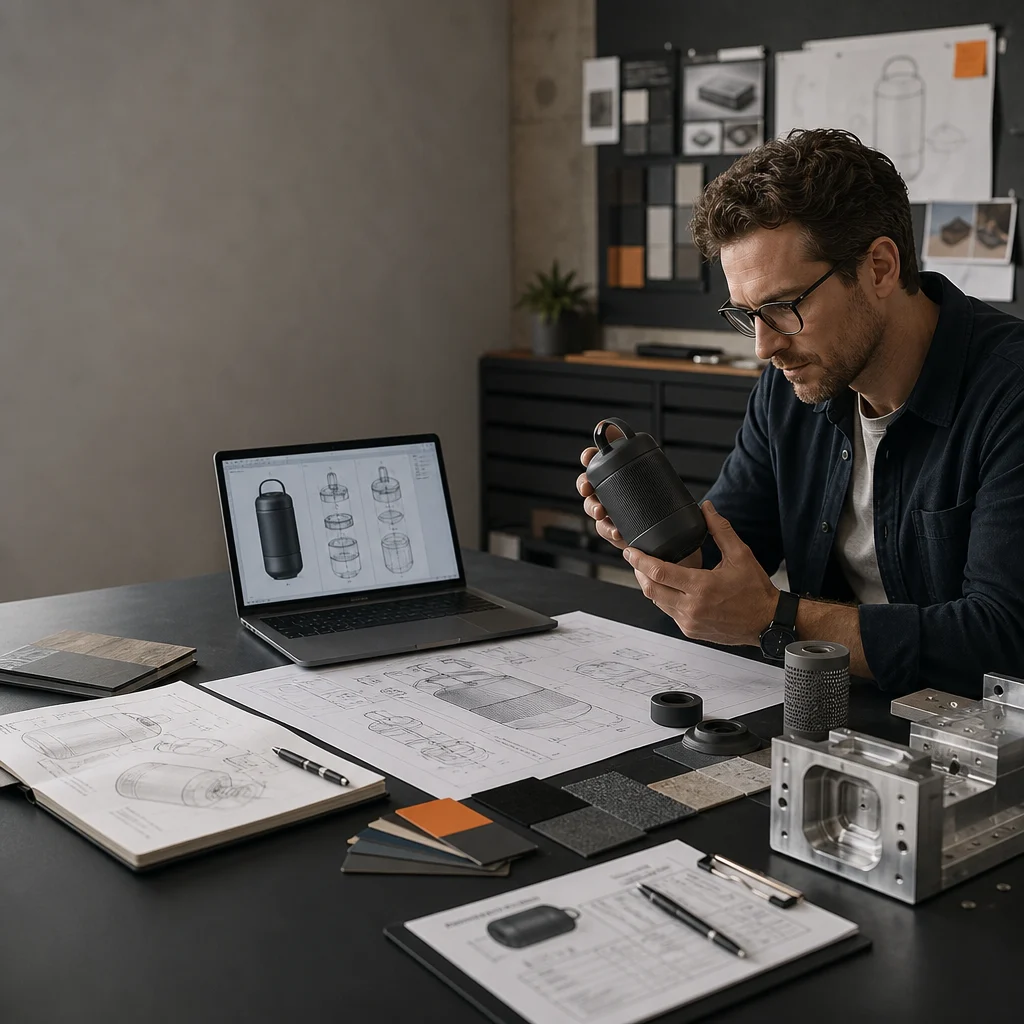
Design for manufacturing (DFM) is the practice of creating product designs that can be produced efficiently at scale. It includes material selection, tolerance specification, assembly planning, and cost optimization. Klugonyx builds DFM into the design process from the beginning rather than treating it as a separate review.
How much do product design and development services cost?
Costs depend on product complexity, number of components, and scope of services. Simple single-part products may cost a few thousand dollars for design work. Multi-component products requiring engineering, prototyping, and factory sourcing represent larger investments. Klugonyx scopes each project individually so clients know what to expect before work begins.
Should I work with a product design firm or a contract manufacturing partner?
A product design firm focuses on creating the product concept and files. A contract manufacturing partner helps you produce at scale. Klugonyx combines both capabilities so you have one team guiding design, engineering, sourcing, and production. This approach eliminates the coordination gaps that occur when multiple vendors are involved.