
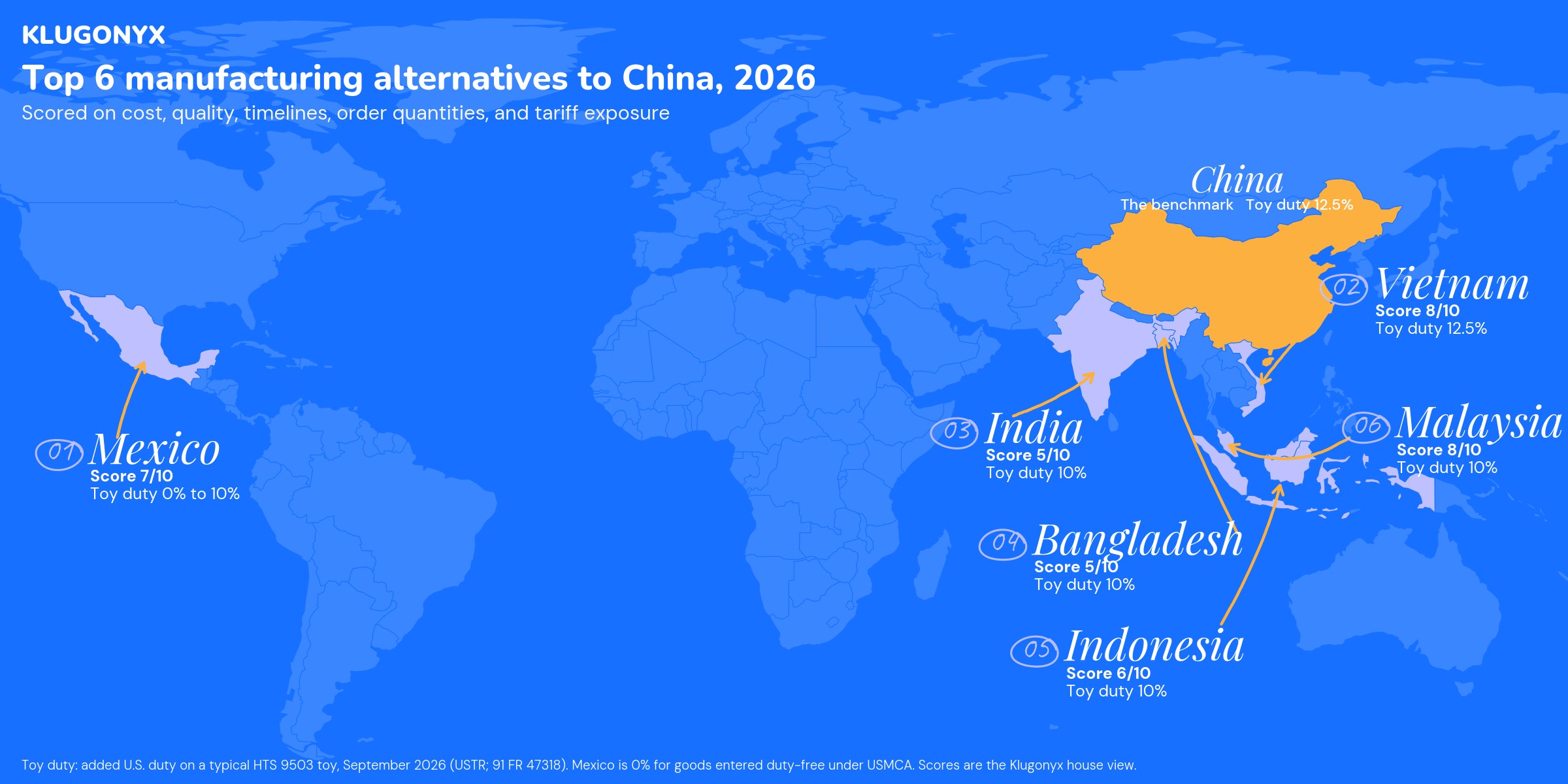
Costs, tariffs, timelines, quality, order quantities, and product specialties for Mexico, Vietnam, India, Bangladesh, Indonesia, and Malaysia.
Skim the takeaways, then jump to the section you need →
China is still the lowest-risk place for most U.S. toy, juvenile, and consumer product brands to make complex hard goods in late 2026. The case for diversifying is now about managing risk, not capturing a big tariff gap: typical Chinese toys pay about 12.5% in added duty, compared with 12.5% from Vietnam and 10% from most other alternatives.
For the past seven years, the question brands asked us was simple: how fast can we get out of China? The answer used to be driven by math. When tariffs on Chinese goods ran far above everywhere else, moving production paid for itself even with higher factory prices, longer lead times, and a messier supply chain.
That math changed in 2026. The Supreme Court struck down the IEEPA tariffs in February. The temporary Section 122 surcharge that replaced them expired in July. What replaced that is a Section 301 "forced-labor" tariff that hits 60 economies at nearly the same rate, and most toys from China sit on a China Section 301 list that has been suspended since 2019.
The result is a tariff landscape where China and Vietnam pay the same added duty on a typical toy, and where the real risks are legal and political: pending court challenges, a pending excess-capacity action that covers every alternative country, and a U.S.-China truce that has only been extended for two months.
This report updates our original guide to manufacturing alternatives to China with verified 2026 data. It covers where China stands today, how the new tariff regime actually works, a country-by-country profile of the six strongest alternatives, what it all means for toys and juvenile products, and a landed-cost framework for deciding what to move and what to keep.
If you want the short version of our advice, it is this: diversify by product type, not by headline. You can see the kinds of products we source across these regions in our toy and game project gallery, and our companion report, The Emerging Brand’s Playbook for the U.S. Toy and Game Industry, covers the market side of the same story.
For complex toys and juvenile hard goods, yes. China's tooling depth, component ecosystems, and decoration and electronics capabilities remain unmatched, and it still made 78.3% of 2024 U.S. toy imports, even as major brands steadily cut their exposure.
The U.S. International Trade Commission's DataWeb figures show that 78.3% of 2024 U.S. toy imports and 85% of Christmas-related imports were made in China (reported by Al Jazeera, May 2025). No other single country comes close.
Even the companies diversifying fastest say China remains essential. Hasbro CEO Chris Cocks told CNBC in May 2025 that China is "always going to be an important place for us to source product," citing specialized skills such as high-end action figures. A month earlier he noted that products with electronics, high-end decoration, and foam components are harder to move (CNBC, April 2025).
That matches what we see on our own factory floors. The categories that move well are simple molded plastics, soft goods, wood, and footwear. The categories that struggle outside China are the ones that depend on a dense web of tier-2 suppliers within a few hours' drive of the assembly line.

For most toys under HTS 9503.00.00, the added duty is 12.5%, not 20%. Most toys sit on China Section 301 List 4B, which has been suspended since December 2019, so they pay only the new 12.5% Section 301 forced-labor tariff on top of a 0% MFN rate.
USTR's August 2019 notice put List 4A in Annex A, and Annex A's Chapter 95 lines are limited to a handful of games (9504.20, 9504.30, 9504.90.90), glass Christmas ornaments (9505.10.10), and sporting goods. HTS 9503.00.00 does not appear there. At the time, USTR said the items delayed to December 15, 2019 (List 4B) included "video game consoles, certain toys". USTR's December 18, 2019 notice then suspended List 4B "until further notice," and its October 28, 2025 notice still described List 4B as suspended.
| HTS (examples) | China 301 list | China 301 rate | Forced-labor 301 | Typical added duty* |
|---|---|---|---|---|
| 9503.00.00 toys (incl. .0021, .0073, .0090) | List 4B (suspended) | 0% | 12.5% | 12.5% |
| 9504.50 video game consoles | List 4B (suspended) | 0% | 12.5% | 12.5% |
| 9504.20, 9504.30, 9504.90.90 games | List 4A | 7.5% | 12.5% | 20% |
| 9505.10.10 glass Christmas ornaments | List 4A | 7.5% | 12.5% | 20% |
| Other 9504 and 9505 lines not in the List 4A annex | Likely List 4B | 0% | 12.5% | 12.5% |
| Many juvenile furniture and housewares lines | List 3 (varies) | 25% | 12.5% | 37.5% plus MFN |
*Excludes MFN duty (0% for most 9503 toys) and the merchandise processing fee. Check each 10-digit code against HTS Chapter 99 (9903.88.15 for List 4A, 9903.88.16 for List 4B) in the USITC HTS and Annex II of the July 28, 2026 forced-labor notice before booking.
Several tariff-calculator sites say Chinese toys pay 20% (7.5% List 4A plus 12.5%). For HTS 9503 goods, that is an error. CBP rulings sometimes pair a 9503 toy with a List 3 or List 4A Chapter 99 number, but that usually applies to a non-toy part of a set, such as a tin carrying case classified separately. Classify every component, then check the list.
Yes. U.S. goods flows have shifted hard toward Mexico and Southeast Asia, and monthly U.S. goods deficits with Mexico and Vietnam now exceed the deficit with China.
The Bureau of Economic Analysis and Census June 2025 trade release showed monthly goods deficits of $16.3 billion with Mexico, $16.2 billion with Vietnam, and $9.4 billion with China. More recently, the Census release of September 3, 2026 reported that the year-to-date U.S. goods and services deficit was down $188.4 billion (29.6%) from 2025, with exports up 12.0% and imports up only 1.9%.
For brands, the takeaway is that the alternatives are no longer small or experimental. They are established export bases with real capacity, and in many categories, real competition for it.
They are diversifying at the margin rather than leaving China. Mattel and Hasbro both target China shares below 40%, spread across seven to ten countries, while keeping complex and electronic products in China.
Mattel. CFO Anthony DiSilvestro said in February 2025 that Mattel sourced from seven countries and expected China to be under 40% of global toy production in 2025, compared with an industry average of about 80%, and that by 2027 no single country should exceed about 25% of global production (Logistics Manager, February 2025). Mattel's FY2025 10-K says it discontinued production at two China plants, one in 2024 and one in 2025, and lists principal facilities in China, Vietnam, Indonesia, Malaysia, Mexico, and Thailand.
Hasbro. CFO Gina Goetter said in February 2025 that Hasbro was on track to cut the share of U.S. toys and games coming from China from 50% to under 40% within two years (NBC, February 2025). In May 2025, CEO Chris Cocks described a goal of about 40% of global sourcing out of China by the end of 2026 and said Hasbro would hit it early (CNBC). Hasbro sourced from eight countries and expected to expand to nine or ten (Supply Chain Dive). Its Q2 2026 10-Q reports tariff costs in cost of sales of about $9.4 million for the quarter and $17.7 million for the first six months of 2026.
If the two largest U.S. toy companies, with dedicated sourcing teams across Asia, still keep roughly 40% of production in China, an emerging brand should be skeptical of any plan that moves everything at once.
China is strong in every toy category. Vietnam, Indonesia, and Malaysia are strong in molded plastics and, for Vietnam and Indonesia, plush and soft goods. Mexico is strong in molded plastics and hard goods. India and Bangladesh are strongest in textiles.
| Category | China | Vietnam | Mexico | India | Indonesia | Malaysia | Bangladesh |
|---|---|---|---|---|---|---|---|
| Electronic toys | High | Medium | Medium | Low | Medium | High | Low |
| Plush and soft toys | High | High | Low | Medium | High | Low | Medium |
| Molded plastic toys | High | High | High | Medium | High | High | Low |
| Dolls and high-deco figures | High | Medium | Medium | Low | High | Medium | Low |
| Games and puzzles | High | Medium | Medium | Medium | Medium | Medium | Low |
| Juvenile hard goods | High | Medium | Medium | Low | Low | Medium | Low |
| Textiles and baby apparel | High | High | Medium | High | High | Low | High |
Klugonyx assessment based on our sourcing projects across these regions. Juvenile hard goods include strollers, seats, and high chairs.
The same rules apply wherever the product is made. Children's products must be tested by a CPSC-accepted third-party laboratory, certified on a Children's Product Certificate, and carry permanent tracking labels. Toys must meet ASTM F963.
Moving a product to a new country means re-testing it from the new factory, even if the design has not changed. Confirm lab coverage near your new supplier in CPSC's list of accepted third-party laboratories, and review the CPSIA requirements for children's products and ASTM F963. Our guide to making safe baby and kids products covers the full compliance path in plain language.
Transpacific rates rose through September 2026. Drewry's World Container Index put Shanghai to Los Angeles at $7,838 and Shanghai to New York at $10,373 per 40-foot container on September 24, 2026, and Drewry expects rates to ease after Golden Week.
Shanghai to Los Angeles climbed from $7,185 on September 3 to $7,352, $7,712, and then $7,838 on September 24. Shanghai to New York went from $9,587 to $9,726, $10,394, and $10,373 over the same weeks. On September 24 the composite index fell 1% to $4,468, and Drewry counted 15 blank sailings for the following week (Drewry, September 2026).
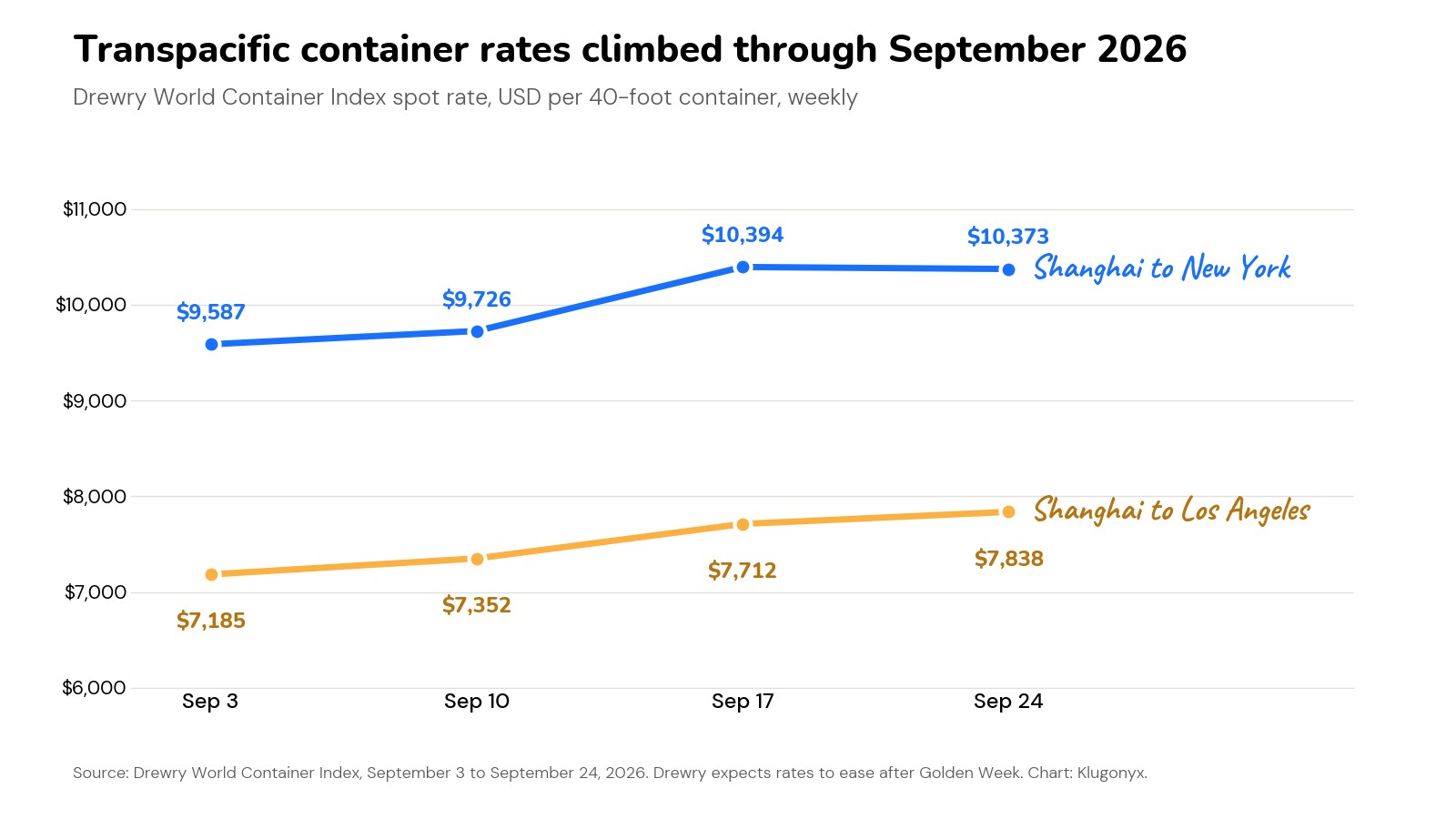
For bulky, low-value goods such as plush, ride-ons, and furniture, freight per unit can rival the tariff difference between countries. That is one more reason Mexico's truck transit matters, and one more reason to model freight per unit rather than per container.
Plan on roughly 30 days of production in China and 30 to 90 days elsewhere, plus 2 to 5 days of transit from Mexico and roughly 15 to 42 days from Asia. These are Klugonyx planning estimates; confirm carrier schedules for your specific port pair.
First runs in a new country take longer than the numbers above. Supplier qualification, new tooling, samples, and CPSC testing typically stretch a first production run in a new country to six to twelve months, based on our project experience. Build that time into your plan before a tariff change forces you to move.
Heavily. Final assembly may move, but tier-2 components, resins, fabrics, and electronics often still come from China, which affects cost, lead time, and how U.S. Customs views your country of origin.
Trade flows show how connected these supply chains are. Even Mexico, the nearshore option, imported $22.36 billion from Vietnam in 2025, including $536 million of toys and parts (UN Comtrade via Trading Economics). A diversification plan should map where every tier-2 component comes from, not just where the final product is assembled.
Own your molds by contract, keep a mold register with photos, and budget for re-validation whenever a mold moves. We found no credible published comparison of mold costs across these countries, so treat any single number with caution.
Practically, most brands cut new tooling in the new country rather than shipping Chinese molds, because relocated molds often need rework and the move can take months. Use NNN agreements (non-disclosure, non-use, non-circumvention) enforceable under local law, register your trademarks in the manufacturing country, and put tool ownership, location, and return rights in the supply contract. A complete tech pack is what makes a factory transfer work.
| Country | Why consider it | 2026 added duty |
|---|---|---|
| Thailand | A Mattel principal manufacturing location; strong in rubber, plastics, and electronics | 12.5%; in the excess-capacity probe |
| Cambodia | Apparel, footwear, and travel goods; a common China-plus-one backup for soft goods | 10%; textile TRQ pending |
| Taiwan | Precision tooling and electronics; higher cost | 10% net of MFN; in the excess-capacity probe |
| Philippines and Turkey | Electronics assembly (Philippines); textiles and home goods near Europe (Turkey) | Verify current tier |
| United States | High-margin, bulky, or speed-critical SKUs; no import duty | None |
Sources: Holland & Knight; Mattel FY2025 10-K; White & Case.
The Smol team used exactly this kind of backup plan. When China tariffs rose, Klugonyx had already established a Cambodia supply chain for the brand during a stable period. Read the Smol case study for the full story.
Compare landed cost per unit, not factory price or tariff rate. Then stress-test every country with a possible excess-capacity tariff, because all seven countries in this report are exposed. Move a SKU only if its advantage survives that test and still covers tooling, re-testing, and ramp-up risk.
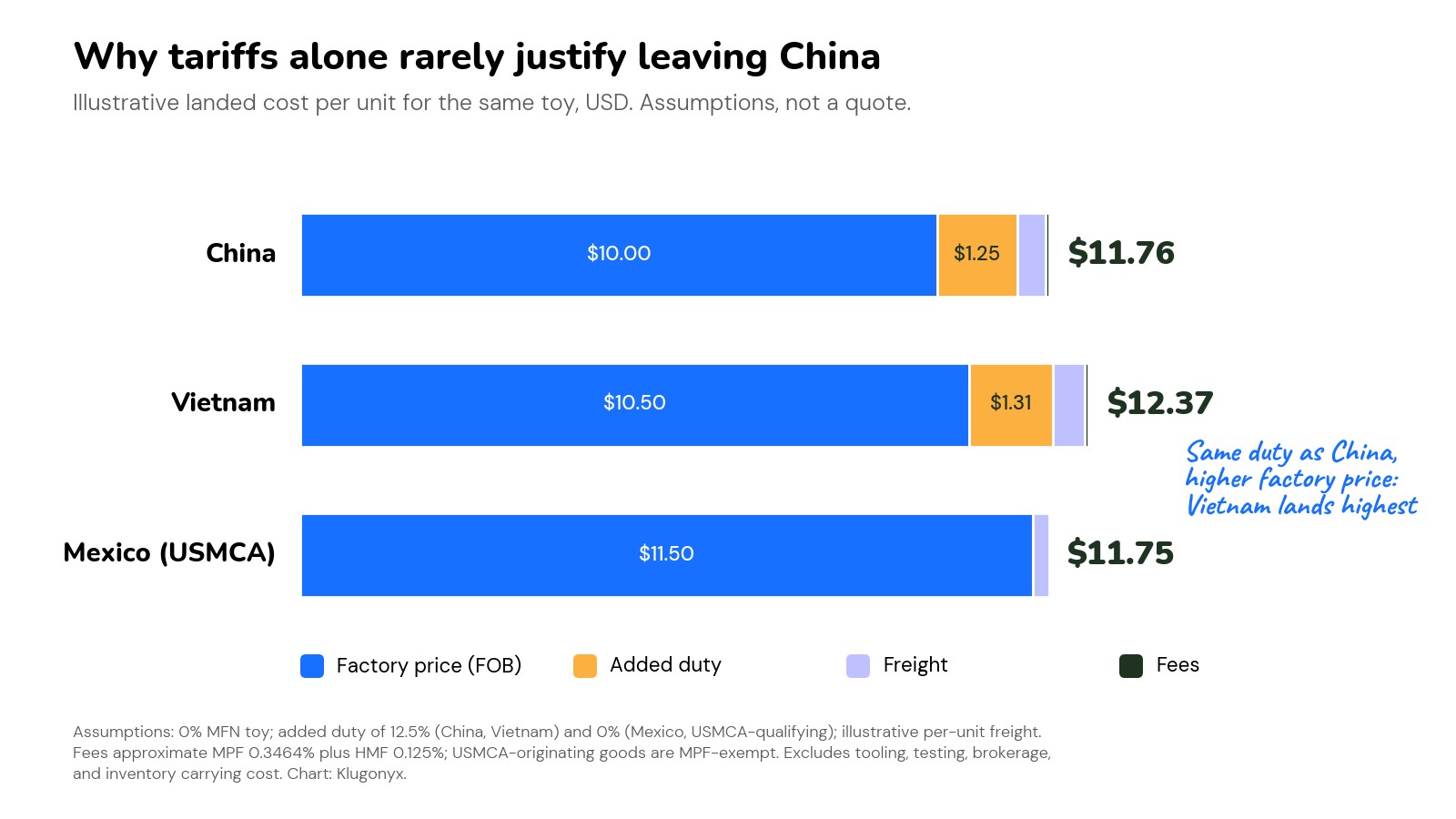
In this example, a factory price just 50 cents higher in Vietnam makes it the most expensive option, even though it pays the same duty as China. Mexico lands at essentially the same cost as China despite a higher factory price, because USMCA-qualifying goods pay no added duty and ship by truck. Your numbers will differ, which is exactly why the model needs to run per SKU.
For a closer look at how we help brands move production without disrupting what already works, see our post on transitioning manufacturing beyond China and our manufacturing capabilities.
It depends on the product. For USMCA-qualifying hard goods, Mexico is strongest because qualifying goods pay 0% added duty and ship by truck in days. For footwear, soft goods, and mid-complexity toys, Vietnam has the deepest capability. Malaysia leads for electronics and precision plastics, and Indonesia for small order quantities. China remains the benchmark for complex, electronic, and high-decoration products.
For most toys under HTS 9503, it is 12.5%: the Section 301 forced-labor tariff on top of a 0% MFN rate and 0% China Section 301, because toys are on the suspended List 4B. Games under 9504.20, 9504.30, and 9504.90.90 and glass ornaments under 9505.10.10 are on List 4A and pay 20%. Always confirm your 10-digit HTS code.
Labor is cheaper in Vietnam, with a mean manufacturing base wage of $302 per month compared with $654 in China (JETRO 2024). But both countries face the same 12.5% added duty on typical toys, and Vietnam often relies on imported Chinese inputs. Whether Vietnam is cheaper depends on the factory price and freight for your specific SKU, so compare landed cost per unit.
Goods of Mexico entered duty-free under USMCA are exempt from the Section 301 forced-labor tariff. Non-qualifying Mexican goods pay 10%. Mexico is, however, included in the pending Section 301 excess-capacity investigation.
Yes, but it is harder than in Asia. Many Mexican factories favor larger, recurring programs, typical MOQs run about 1,000 to 5,000 units, and there is no Alibaba-style marketplace. Most emerging brands reach smaller, flexible shops through a sourcing partner or industry associations.
Yes. CBP's CAPE tool, launched April 20, 2026, processes refunds of an estimated $166 billion in IEEPA duties paid by about 330,000 importers. Only the importer of record or its filing broker can submit. China Section 301, Section 232, and forced-labor duties are not refundable through CAPE.
We found no current legal basis for it after the IEEPA tariffs were terminated in February 2026. Transshipment and false country-of-origin claims are still pursued through civil penalties under 19 U.S.C. 1592, EAPA investigations, and reassessment at the correct rate.
Possibly. USTR's pending excess-capacity investigation covers China, Mexico, Vietnam, India, Bangladesh, Indonesia, Malaysia, Thailand, Cambodia, and Taiwan, among others, and any resulting tariffs would likely stack on top of the forced-labor tariffs. As of September 25, 2026, no action had been proposed.
China made 78.3% of 2024 U.S. toy imports by value. Among the alternatives, Vietnam, Indonesia, Mexico, Malaysia, and Thailand are established toy manufacturing bases, and all appear among Mattel's principal manufacturing locations in its FY2025 10-K.
Drewry's September 24, 2026 index put Shanghai to Los Angeles at $7,838 and Shanghai to New York at $10,373 per 40-foot container, and Drewry expected rates to ease after Golden Week. Model freight per unit, since it can rival tariff differences on bulky goods.
Primary sources are marked (P). Cost levels, lead times, MOQs, quality grades, capability ratings, and scores are Klugonyx estimates from our own sourcing projects. Tariff policy changes often; recheck every rate on the date of entry.
Tell us what you make, where you make it today, and what your volumes look like. We will model landed cost across the countries that fit your product and tell you what your path actually looks like, including when staying put is the right answer.