
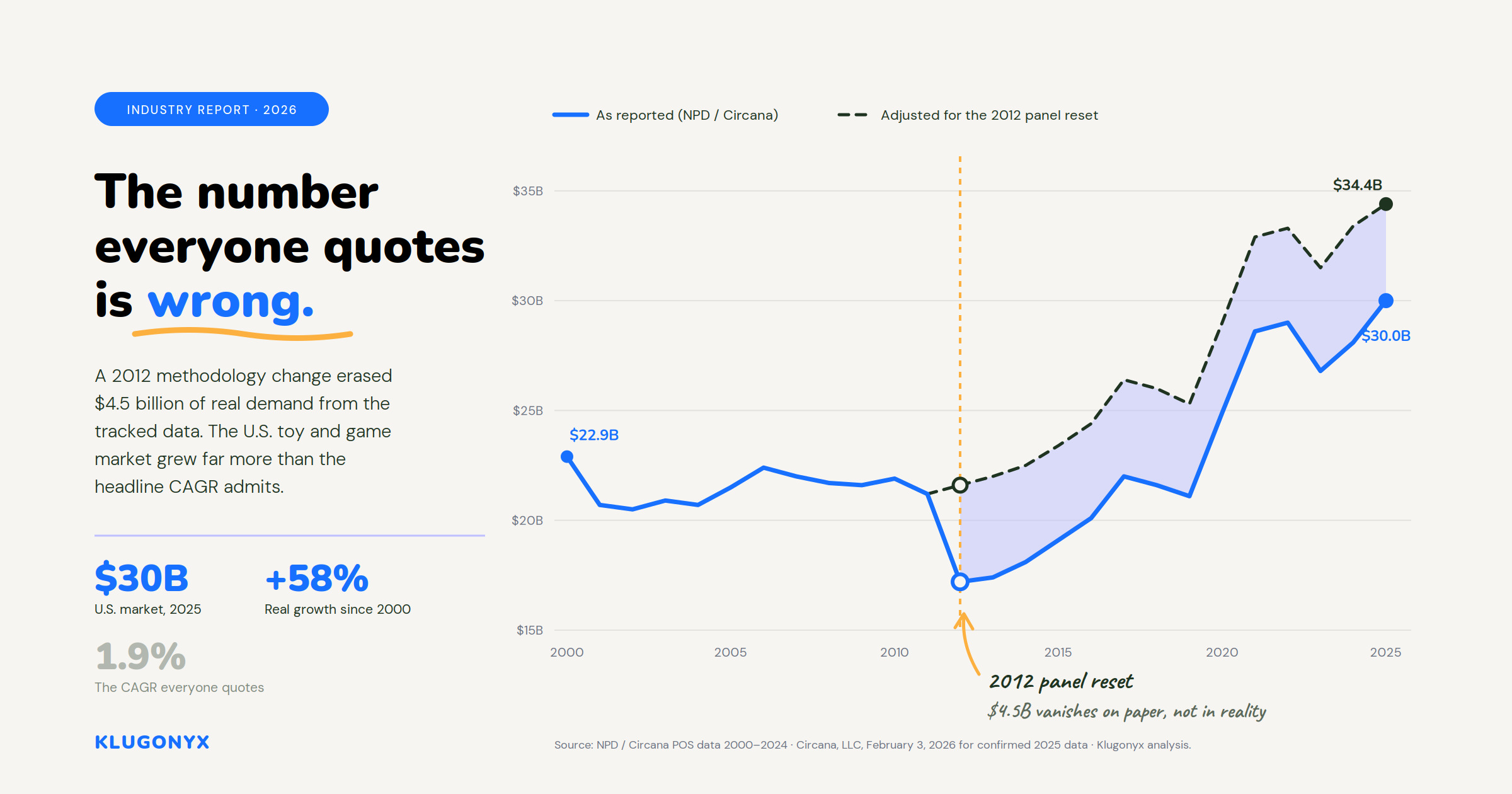
The U.S. toy and game industry is a $30 billion market that grew more than $10 billion in real terms over 26 years, returned to 6% growth in 2025, and now sits roughly 35% above its 2019 baseline. The opportunity for emerging brands is wider than the headline CAGR suggests, but it closes fast for founders who treat safety compliance, design for manufacturability, and factory vetting as finishing steps rather than as the work itself.
The U.S. toy and game industry has a perception problem. A 1.9% compound annual growth rate sounds modest. A market dominated by Mattel, Hasbro, and Lego sounds impenetrable. A category that saw a historic pandemic spike followed by a sharp correction sounds volatile and risky.
None of those readings tell the full story.
Over the last 25 years, the industry grew by more than $10 billion in real terms, proved more resilient than nearly every other consumer category during economic downturns, and quietly developed several high-growth niches that are outpacing the broad market by double digits. The brands winning inside those niches right now are not the giants. They are lean, founder-led companies that identified a specific unmet need, built a well-designed product around it, and got their manufacturing and supply chain right before they ran out of runway.
You can see what that looks like in practice in our toy and game project gallery.
This white paper makes a simple argument: the window for emerging toy and game brands is wider than the headline numbers suggest, but it closes fast for founders who misread the operational requirements of the category. Safety compliance, design for manufacturability, factory vetting, and retail readiness are not finishing steps. They are the work. The brands that treat them that way scale. The brands that treat them as administrative hurdles almost never make it to a second product.
In 2025, the industry confirmed that thesis. Following two years of stagnation, the U.S. toy market returned to 6% growth, its strongest non-pandemic performance in more than a decade, driven not by broad-based volume but by a concentrated bet on premium products, licensed IP, and fandom-driven collectibles. That is a category being shaped by exactly the kind of brands this paper is written for.
What follows is a 26-year look at the market and what it reveals, a map of where the real growth lives today, an honest breakdown of what it takes to enter the category successfully, and four case studies from brands that made it work.
Because a 2012 NPD Group methodology change removed $4 to $5 billion of real sales from the tracked series without any decline in consumer demand. Adjusting for that reset, the market grew roughly $10.4 billion (about 58%) between 2000 and 2025, not the $7 billion (about 30%) the raw series shows.
Ask anyone familiar with the toy and game industry what the long-term growth rate looks like and you will hear some version of the same answer: steady, modest, mature. The 1.9% CAGR from 2000 to 2025 is technically accurate and practically misleading at the same time.
The U.S. toy and game market, as tracked by NPD Group (now Circana), grew from approximately $23 billion in 2000 to $30 billion in 2025. That is $7 billion in net growth on the reported series, or roughly 30% in nominal terms. Adjust for a significant methodology change in 2012, and the real picture is closer to $10.4 billion in growth, or about 58%.
That methodology change matters enough to explain in full, because it created a persistent misunderstanding about the health of the category that affects how people evaluate the opportunity today.
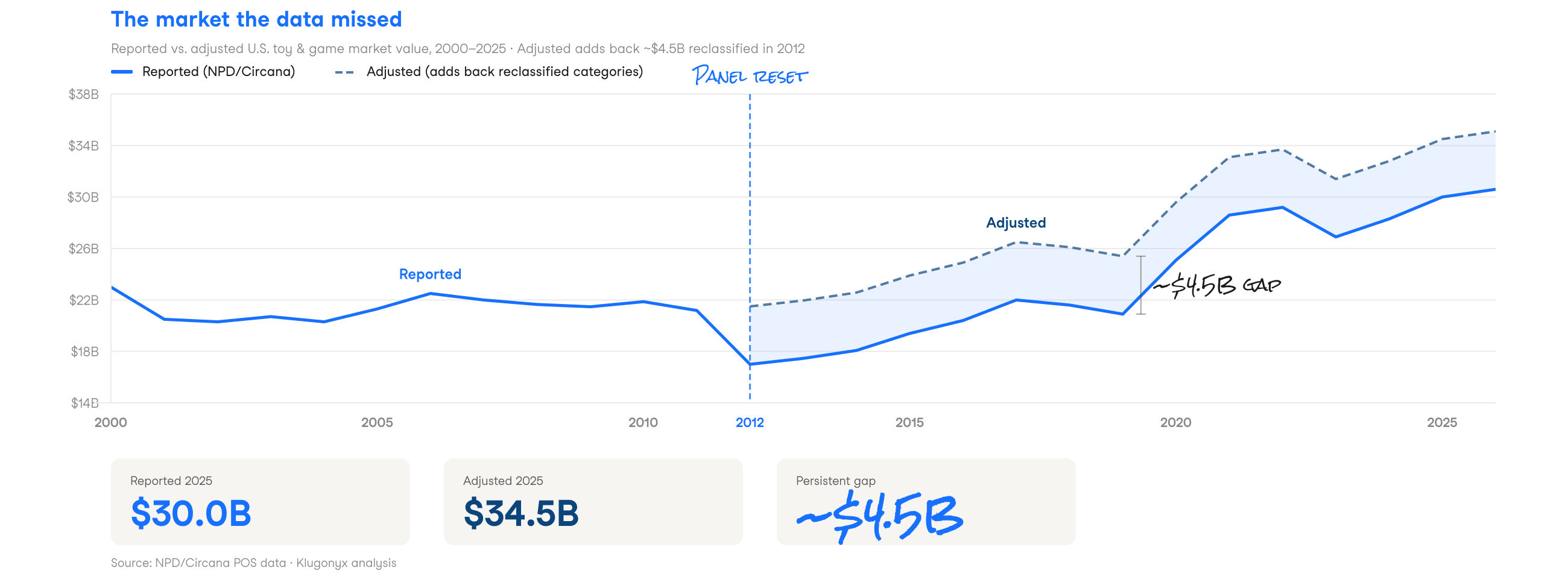
In 2012, NPD Group conducted what it called a “panel reset,” a requalification of how it tracked toy and game sales at the point of sale. The stated goal was to improve accuracy by focusing on retailers with verifiable UPC-based transaction data. The practical effect was that a significant portion of the market dropped out of the reported figures entirely, not because those sales disappeared, but because the outlets where they happened were no longer tracked.
The categories and retail channels that fell out of NPD’s coverage after 2012 included independent hobby shops and specialty toy retailers without UPC-based inventory systems, museum and zoo gift stores, seasonal mall kiosks, small dollar and grocery formats, and theme park vendors. Several product categories were also reclassified into other verticals: hobby-grade R/C vehicles moved to Sporting Goods, large outdoor playsets moved to Outdoor/Sporting Goods, child-targeted tablets and smart speakers moved to Consumer Electronics, and digital game sales shifted to their own tracking category.
The net effect was a reported market decline of approximately $4 to $5 billion between 2011 and 2012, from roughly $21.18 billion to $17 billion. Consumer demand in those categories did not fall. They simply became invisible to the methodology.
For anyone evaluating the toy industry based on the raw CAGR, this is the correction that transforms the story. The post-2012 market is smaller only on paper.
Peaks in the toy category are driven by cultural moments (Pokemon, Star Wars, Webkinz, COVID lockdowns) rather than gradual demand growth. Troughs are shallower than in other consumer categories, because parents keep buying toys even when they cut other spending. That combination means high volatility on the upside and structural resilience on the downside.
The 26-year chart is not a flat line. It moves with the culture, with the economy, and occasionally with a single toy that captures the world’s attention for six months. Understanding what drove the peaks and valleys matters more than the average, because it reveals the underlying mechanics of the category.
The peaks are not random. The 2000 high was driven by Pokemon and Star Wars Episode I licensing. The 2006 surge was Webkinz and TMX Elmo. The 2015 spike was Star Wars: The Force Awakens adding an estimated $700 million in licensed product sales. The 2020 explosion at plus 16% happened because 330 million Americans were locked inside with their children and nothing to do. Games and puzzles alone grew 38% that year. And in 2025, Pokemon alone generated $2.5 billion in U.S. toy sales, up 87% year over year, becoming the first single property to exceed $2 billion in a calendar year in at least two decades.
What those peaks share is not luck. They reflect a category that responds faster and more dramatically to cultural moments than almost any other consumer goods vertical. The downside is volatility. The upside is that a well-positioned brand at the right cultural moment can see growth that no amount of marketing spend could manufacture.
The troughs reveal resilience, not fragility. The 2001 to 2003 decline followed 9/11 and the dot-com collapse. The 2008 financial crisis hit the broader economy harder than it hit toys. The 2022 to 2023 correction followed one of the most unusual demand periods in the category’s history. In each case, toys underperformed expectations on the downside relative to other consumer categories. Parents keep buying toys even when they cut other spending. That is structural, not coincidental.
| Year | What happened | Direction |
|---|---|---|
| 2000 | Pokemon and Star Wars Episode I licensing lift toy sales to a modern-era high of $23B | Growth |
| 2001 | 9/11 and the dot-com bust cause toy sales to drop approximately $3B | Decline (-11%) |
| 2002 | Sales remain flat. Walmart and Toys R Us begin price wars | Flat |
| 2003 | Harry Potter and Bratz help stabilize sales, still down from the 2000 high | Stabilizing |
| 2004 | Nintendo DS and PSP launch. Many U.S. toy stores file bankruptcy due to price competition | Decline |
| 2005 | First “kidult” toy collections emerge (Lego Star Wars, PSP collectables) | Growth |
| 2006 | Webkinz and TMX Elmo drive the hottest holiday toy sales of the decade | Growth |
| 2007 | Mass toy recall over lead paint hurts consumer trust and stalls growth | Decline |
| 2008 | Great Recession hits, but toys outperform the wider market | Decline |
| 2009 | Movie toy licensing drives 25% of toy sales. Building sets and arts and crafts see an uptick | Growth |
| 2010 | iPad launches but physical building set sales (Lego) boom by 13% | Growth |
| 2011 | Toys R Us enters debt crisis. App stores drive a rise in game sales. Ecommerce takes center stage | Decline |
| 2012 | NPD “panel reset” removes $4 to $5B from tracked figures through methodology change, not real demand decline | Reporting change |
| 2013 | Out-of-the-box craft kits and the Rainbow Loom craze | Growth |
| 2014 | Frozen toy licensing and educational STEM tablets spark a sales uptick | Growth |
| 2015 | Star Wars: The Force Awakens adds $700M to toy sales | Growth |
| 2016 | Hatchimals and film licensing boom | Growth |
| 2017 | Fidget spinners and blind-bag minis drive a boom | Growth |
| 2018 | Toys R Us closes all U.S. stores, removing 15% of toy shelf space | Decline |
| 2019 | Kidult segment contributes 20% of industry sales in a slow year | Flat |
| 2020 | COVID lockdown sparks the “play wave.” Total category up 16%, games and puzzles up 38% | Growth (+16%) |
| 2021 | Stimulus payments drive toy and game sales up 13% | Growth (+13%) |
| 2022 | Inflation lifts toy prices and sales stagnate | Flat |
| 2023 | High inflation and interest rates cause a post-pandemic correction | Decline (-8%) |
| 2024 | Flat growth. Toy sales remain approximately 26% above 2019 levels | Flat |
| 2025 | Pokemon drives $2.5B in U.S. toy sales (+87% YoY), the first property to crack $2B in a single year in at least two decades. Games and Puzzles emerges as the largest supercategory at $4.9B | Growth (+6%) |
| 2026 | Solid licensing and collectibles momentum meets significant supply chain uncertainty. China import tariffs drive order delays across mid-size and small brands. A U.S.-China tariff pause in May 2026 provides partial relief | Projected (+2%) |
Confirmed 2025 figures: Circana, February 3, 2026. For supply chain strategy in the current tariff environment, see our guide to transitioning manufacturing beyond China.
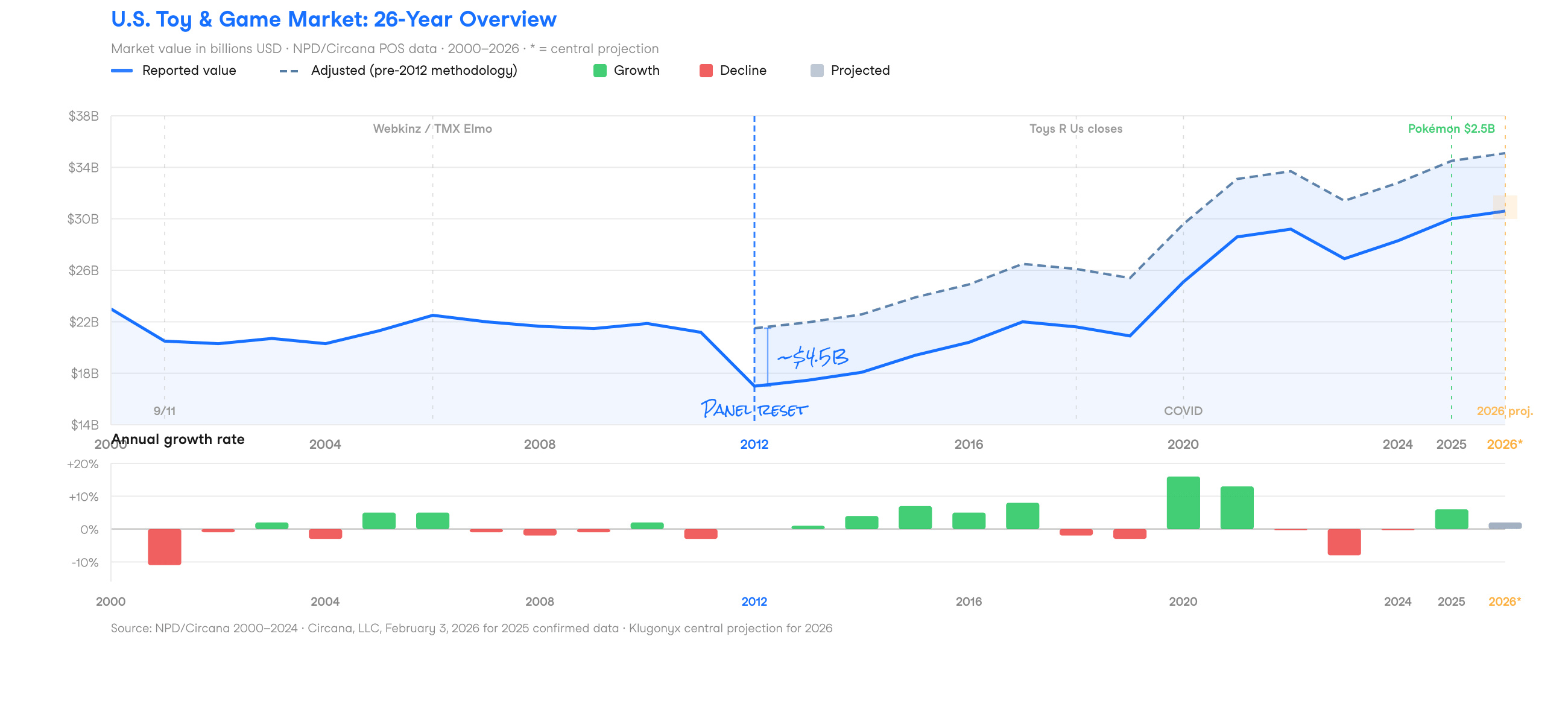
For an emerging brand evaluating the market today, the right comparison is not the 2020 to 2021 pandemic peak. It is the 2019 pre-pandemic baseline. Toy sales in 2025 sit approximately 35% above 2019 levels on the tracked Circana series.
The category has now demonstrated positive growth through three distinct post-pandemic phases: the 2020 to 2021 surge, the 2022 to 2023 correction, and the 2025 recovery. Each phase has resolved higher than its starting point. That is a category with structural resilience, not a one-time spike that has since normalized away.
Total annual dollar sales grew by 6%, average selling price rose 4%, and units sold increased by 3%. Six of 11 supercategories posted dollar growth, led by Games and Puzzles (+37%), Building Sets (+15%), and Explorative and Other Toys (+20%). These three supercategories contributed 92% of all toy industry growth in 2025.
Source: Circana, LLC, February 3, 2026.
The U.S. toy industry enters 2026 with solid momentum, supported by licensing, collectibles, and a strong content pipeline, but with meaningful uncertainties ahead. While tariffs have not yet materially impacted prices for consumers, their downstream effects remain unpredictable. A U.S.-China tariff pause in May 2026 partially relieves pressure on the 77% of toys imported from China, but the full downstream effects on production schedules and consumer pricing remain unresolved.
Sources: Circana, February 2026; The Toy Association member survey, April 2025.
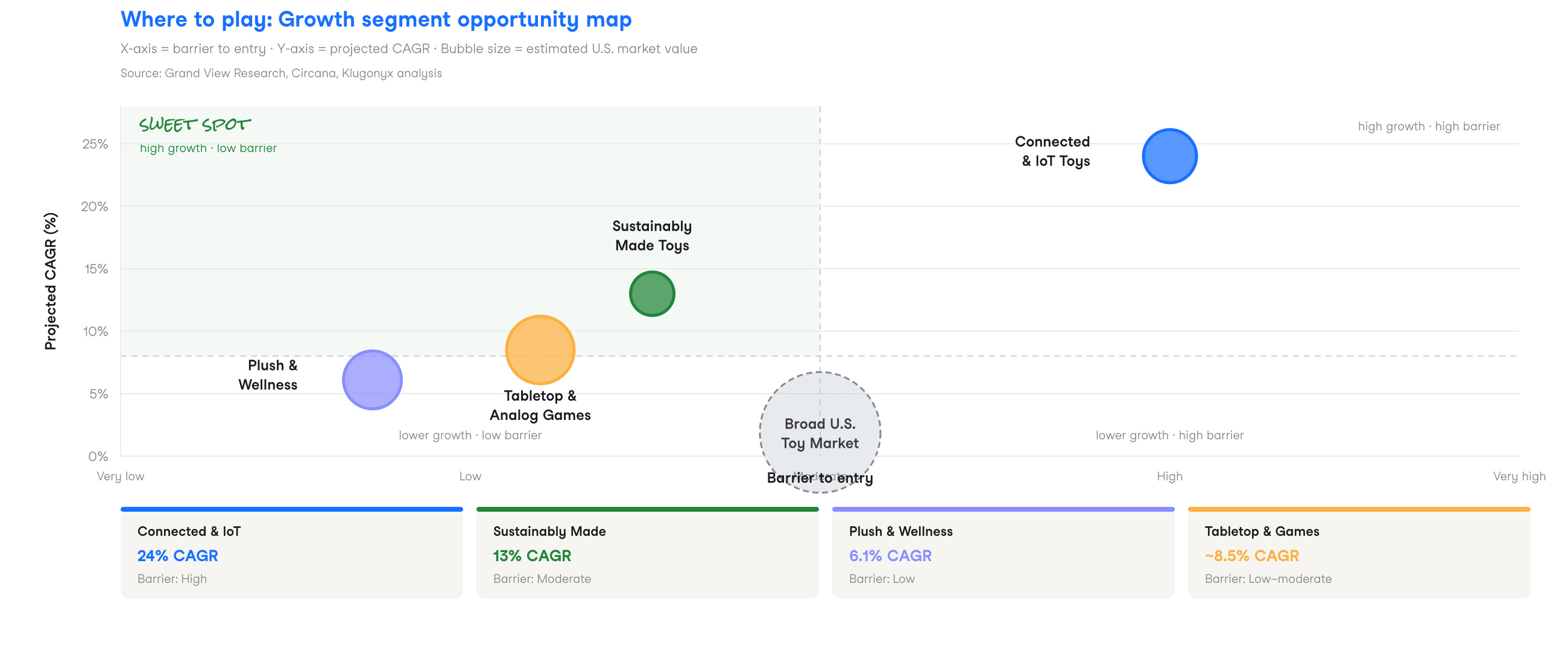
Inside the broad toy and game market, several segments are growing at two to five times the overall rate. They share one characteristic: they serve customers the traditional toy industry largely ignored, above all adults buying for themselves.
A 1.9% CAGR is an average. Averages flatten the distribution. Inside the broad toy and game market, several segments are growing at two to five times the overall rate, and those segments share a common characteristic: they serve customers the traditional toy industry largely ignored.
The most important shift in the last five years is demographic, not technological. Birth rates in the United States and most developed markets have been declining steadily. The 0 to 9-year-old cohort, the historical core of the toy market, is shrinking as a share of the population. The toy industry’s response to that reality has reshaped the category in ways that create real opportunity for emerging brands.
Consumers over the age of 12 now account for approximately 25% of all U.S. toy and game revenue. Sales to recipients aged 18 and older grew 18% in the first half of 2025, nearly evenly split between men and women.
The term “kidult” entered the toy industry’s vocabulary around 2019, but the behavior it describes goes back further. Adults have always bought toys, collectables, and games for themselves. What changed is the scale of it.
That 25% share grew 58% between 2021 and 2022 alone, according to Circana, and the trend accelerated further in 2025 (Circana, H1 2025). Growth in the 9 to 11 age group reached 9% and the 12 to 17 segment grew 6%. The implication is that the toy category’s most reliable growth engine is no longer the 0 to 9-year-old cohort that defined the industry for most of its history. It is adults buying for themselves, and older children buying with a collector’s mindset.
For emerging brands, the kidult segment offers something structurally attractive: buyers with higher disposable income, lower price sensitivity, and stronger loyalty to products that resonate with their identity. A well-designed product at $45 targeting an adult hobbyist in a specific niche outperforms a commodity toy at $12 fighting for shelf space against companies with nine-figure marketing budgets.
The strategic implication is significant. Emerging brands that position in the kidult or collector segment can compete on design quality, brand storytelling, and community rather than on production scale and distribution reach, which are exactly the dimensions where large incumbents have the advantage.
| Segment | Projected growth | Barrier to entry | Why it matters for emerging brands |
|---|---|---|---|
| Connected and IoT toys | 24% globally by 2030 | High | Premium price points and defensible IP, offset by software testing and children’s data privacy requirements |
| Sustainably made toys | 13% global CAGR through 2032 | Moderate | Higher production cost, but higher price tolerance among the parents who prioritize it |
| Plush and emotional wellness | 6.1% CAGR through 2030 | Low | TikTok can take a product from niche to sellout in days, but the space crowds fast once a format goes viral |
| Tabletop and analog games | Grew 37% in 2025 to $4.9B | Low to moderate | Strong independent retail channel, active enthusiast communities, and a crowdfunding ecosystem for demand validation |
STEM electronics, app-enhanced physical toys, AI voice integration, robotics kits, and augmented reality play experiences represent the category with the highest projected growth and the highest barrier to entry. The connected toy segment is forecast to grow 24% globally by 2030. The compliance complexity is real: software components add layers of testing requirements, and connectivity features bring data privacy regulations into scope for products targeting children.
Our toy and game design page outlines how we handle compliance planning from the first design brief. The premium price points and defensible intellectual property this segment allows make it worth the investment for the right brand.
Consumer demand for toys made with recycled materials, FSC-certified wood, and non-toxic finishes has moved from a marketing claim to a purchasing criterion. The sustainably made toy segment is forecast to grow at a 13% global CAGR through 2032. The production cost is higher, but so is the price tolerance among the parents who prioritize it. The brands that build sustainable sourcing into their supply chain from the beginning will be better positioned than those retrofitting it after the fact.
Plush has always cycled through boom and bust periods. What is different now is the amplification mechanism. TikTok virality can drive a plush product from niche to sellout in days rather than seasons. Combined with a documented rise in emotional wellness gifting across age groups, the plush segment carries a 6.1% projected CAGR through 2030. The low barrier to entry also means the space gets crowded quickly when a format goes viral, which makes differentiated design and brand identity more important than ever.
Board game and puzzle sales grew 38% during the 2020 lockdowns and have not fully retreated. Sales remain approximately 70% above 2019 levels. The “put the phone down” and intentional family time movements are durable cultural trends rather than pandemic-specific behaviors. The tabletop category also benefits from a strong independent retail channel, active enthusiast communities, and a robust crowdfunding ecosystem that lets emerging brands validate demand before committing to full production runs.
The 2025 results validated the tabletop and games category’s durability most dramatically. Games and Puzzles emerged as the largest toy supercategory in 2025, generating $4.9 billion in U.S. sales, up 37% year over year, driven primarily by Pokemon trading cards (Circana, February 2026). The category’s growth was not solely a trading card story: the broader shift toward analog, community-oriented play continues to compound.
For emerging brands in the tabletop space, 2025 established that this segment can sustain outsized growth even in a year of broader category normalization. Browse our toy and game project gallery to see examples of the range of products we have brought to market across age groups and play patterns.
Average selling price, not unit volume, is now the primary driver of brand health in toys. Premium products priced between $30 and $69.99 grew 18% in 2025, and category ASP rose 4% after three consecutive flat years. That removes one of the biggest structural disadvantages of being a small brand.
For most of the toy industry’s history, winning meant moving more units. Shelf space was won through volume, and volume was won through low prices. That model favored companies with the manufacturing scale to compete at $9.99 or below, which is to say it favored the giants.
The post-pandemic toy market looks different. Premium-positioned products are outperforming their volume equivalents. The 2025 data confirms this structurally (Circana, H1 2025). Consumers did not simply pay more for the same things. They deliberately traded up to products they valued more.
For an emerging brand, this shift removes one of the most significant structural disadvantages of being small. You will never out-manufacture Hasbro. You can out-design them in a niche. You can out-story them with a specific buyer. And if you price accordingly, you can build a healthy margin structure without needing the unit volume that would require a $20 million production budget to achieve.
These brands are not competing in the volume-driven, mass-market segment. They are building products that earn their price point through design quality, material investment, and focused market positioning.
Design decisions made early in development are what make a premium price point defensible at retail. Our post on design for manufacturability explains how to build quality and margin into a product from the first sketch, before any tooling investment is made. For common questions about cost and timeline, our FAQs page covers the most frequent questions we hear from founders in the early stages.